


Page 44 - ARNM-1-1
P. 44
Advances in Radiotherapy
            & Nuclear Medicine                                                CCRT plus nimotuzumab for cervical cancer


            2.3. Evaluation and follow-up                      Table 1. Characteristics of patients (n=34)

            We  evaluated  therapeutic  efficacy  by  imaging  (MRI  and                      No.   Percentage
            CT) and gynecological examinations 1 and 4 months after   Initial stage (FIGO 2009)
            treatment. Re-examination was performed every 3 months   IB1                       1       2.9
            within 2 years, every 6 months within 3 – 5 years, and
            every year thereafter. All evaluation was based on response   IB2                  6       17.6
            evaluation criteria in solid tumors 1.1 .           IIA2                           6       17.6
                                          [10]
                                                                IIB                           13       38.2
              Complete remission (CR) was defined as the
            disappearance of all target lesions and a reduction in the   IIIB                  5       14.7
            short diameter of all pathological lymph nodes to <10   IVA                        3       8.8
            mm. Partial remission (PR) was defined as a reduction   Pathological type squamous cell carcinoma  34  100
            in the total diameter of the target lesions by at least 30%   Maximum diameter of tumor (cm)  4.83±1.13 Not applicable
            compared to the baseline level. Progressed disease (PD)   Parametrial involvement  18      52.9
            was defined as an increase in the total diameter of the   Pelvic lymph node metastases  22  64.7
            target lesions by at least 20% compared to the minimum   Para-aortic lymph node metastases  8  23.5
            value of the sum of the target lesion diameters. Meanwhile,
            the absolute value of the sum of diameter must increase by
            5 mm (the presence of one or more than one new lesion   only completed 4–5 sessions of concurrent chemotherapy
            was also regarded as PD). Stable disease was defined as the   due to bone marrow suppression or numbness.
            reduction of target lesions between PR and PD. Disease-  RT lasted more than 8 weeks in 23.5% (8/34) of
            free  survival  (DFS)  time  was  defined  as  the  time  from   patients and 31.0% (12/34) underwent four cycles of
            CR to disease progression or the last follow-up or death.   adjuvant chemotherapy. One patient required a surgical
            Progression-free survival (PFS) time was defined as the   hysterectomy 6 months after RT, and the post-operative
            time from the beginning of treatment to tumor progression   pathological result was negative.
            or the last follow-up or death. Local PFS was defined as
            the time from the beginning of treatment to local tumor   3.2. Side effects
            progression or the last follow-up or death. Overall survival   Acute side effects noted during the concurrent treatment
            (OS) time was defined as the time from the beginning of   are shown in Table 2. One patient experienced a sensation
            treatment to death. The side effect was evaluated according   of numbness developing from the back to lower limbs
            to the common terminology criteria for adverse events   when treated with cisplatin and nimotuzumab on the 1 st
            4.03 standard, which was defined as acute reactions within   day. Thereafter, treatment with cisplatin was stopped, but
            90 days after RT and chronic reactions more than 90 days   nimotuzumab was continued until the end of treatment.
            after RT.
                                                               Twenty of the 34 patients showed late toxicities (Table 3).
            2.4. Statistical analysis                          One  patient  developed  vaginal  and  rectal  fistulas  6
                                                               months after RT and underwent a colostomy. There was
            SPSS  21.0  software  was  used  for  data  analysis.  Kaplan–  one case of intestinal obstruction 4 months after RT,
            Meier method and log-rank test were used for the survival   which was treated by performing surgery. One patient
            analysis. The counting method was used for side effect   developed a Grade 2 rectal hemorrhage 7 months after
            analysis. P < 0.05 was considered statistically significant.
                                                               RT. There were two cases of Grade 3 vaginal stenosis.
            3. Results                                         Grade 2 hematuria occurred 2 and 3.8 years after RT in
                                                               two cases, respectively.
            3.1. General information
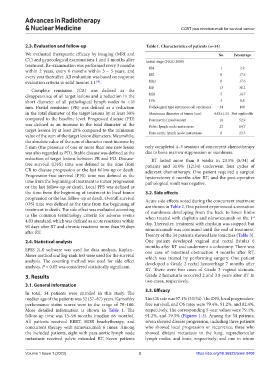
            In total, 34 patients were enrolled in this study. The   3.3. Efficacy
            median age of the patients was 52 (37–67) years. Karnofsky   The CR rate was 97.1% (33/34). The DFS, local progression-
            performance status scores were in the range of 70–100.   free survival, and OS rates were 79.4%, 91.2%, and 82.4%,
            More detailed information is shown in  Table  1. The   respectively. The corresponding 5-year values were 79.4%,
            follow-up time was 13–98 months (median 66 months).   91.2%, and 79.3% (Figures 1-3). Among the 34 patients,
            All patients received EBRT, HDR brachytherapy, and   seven showed disease progression, including three patients
            concurrent therapy with  nimotuzumab  6 times. Among   who showed local progression or recurrence; three who
            the included patients, eight with para-aortic lymph node   showed distant metastasis to the lung, supraclavicular
            metastasis  received pelvic  extended  RT. Seven patients   lymph nodes, and bone, respectively; and one in whom


            Volume 1 Issue 1 (2023)                         3                       https://doi.org/10.36922/arnm.0408

