


Page 46 - ARNM-1-1
P. 46
Advances in Radiotherapy
            & Nuclear Medicine                                                CCRT plus nimotuzumab for cervical cancer


                                                               regarded as an independent adverse prognostic factor
                                                               of cervical cancer and an indicator to predict the poor
                                                               efficacy of RT and chemotherapy for cervical cancer [18,19] .
                                                               A number of studies have confirmed that nimotuzumab
                                                               monotherapy or combined with RT and chemotherapy is
                                                               well tolerated in the treatment of various advanced solid
                                                               tumors without increasing adverse reactions, and could
                                                               improve efficacy,whether EGFR overexpression is positive
                                                               or negative [20-24] .
                                                                 Compared to three-dimensional conformal RT, IMRT
                                                               has been associated with significantly fewer toxicities.
                                                               A retrospective cohort study found that the incidence
                                                               of Grade 2 acute gastrointestinal reaction was 45%, and
                                                               the incidence of Grade 3 or higher acute gastrointestinal
                                                               reactions was only 2% . One prospective study found
                                                                                  [25]
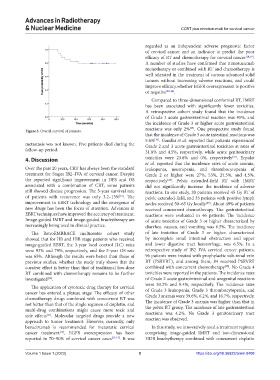
            Figure 3. Overall survival of patients.
                                                               that the incidence of Grade 3 acute intestinal reactions was
                                                               5.6% . Gandhi et al. reported that patients experienced
                                                                   [26]
            metastasis was not known. Five patients died during the   Grade 2 and 3 acute gastrointestinal toxicities at rates of
            follow-up period.                                  31.8% and 4.5%, respectively, while acute genitourinary
                                                                                                    [27]
            4. Discussion                                      toxicities were 23.8% and 0%, respectively . Erpolat
                                                               et al. reported that the incidence rates of acute anemia,
            Over the past 20 years, CRT has always been the standard   leukopenia, neutropenia, and thrombocytopenia of
            treatment for Stages IB2–IVA of cervical cancer. Despite   Grade 2 or higher were 27%, 53%, 24.5%, and 4.5%,
            the reported significant improvement in DFS and OS   respectively . Pelvic extended-field RT with IMRT
                                                                        [28]
            associated with a combination of CRT, some patients   did not significantly increase the incidence of adverse
            still showed disease progression. The 5-year survival rate   reactions. In one study, 20 patients received 45 Gy RT of
            of patients with recurrence was only 3.2–13% . The   pelvic extended-field, and 33 patients with positive lymph
                                                    [11]
            improvement in EBRT technology and the emergence of   nodes received 50–65 Gy locally . About 49% of patients
                                                                                         [29]
            new drugs has been the focus of attention. Advances in   received concurrent chemotherapy. The gastrointestinal
            EBRT techniques have improved the accuracy of treatment.   reactions were evaluated in 46 patients: The incidence
            Image-guided IMRT and image-guided brachytherapy are   of acute toxicities of Grade 3 or higher characterized by
            increasingly being used in clinical practice.      diarrhea, nausea, and vomiting was 6.5%. The incidence
              The RetroEMBRACE multicenter cohort study        of late toxicities of Grade 3 or higher, characterized
            showed that for IIB and IIIB stage patients who received   by incomplete small intestinal obstruction and upper
            image-guided EBRT, the 3-year local control (LC) rates   and lower digestive tract hemorrhage, was 6.5%. In a
            were 93% and 79%, respectively, and the 5-year OS rate   retrospective study of IB2–IVA cervical cancer patients,
            was 65%. Although the results were better than those of   96 patients were treated with prophylactic sub-renal vein
            previous studies, whether the study truly shows that the   RT (PSRVRT), and among them, 84 received PSRVRT
                                                                                                 [30]
            curative effect is better than that of traditional low-dose   combined with concurrent chemotherapy . No Grade 4
            RT combined with chemotherapy remains to be further   toxicities were reported in the patients. The incidence rates
            investigated .                                     of Grade 2 acute gastrointestinal and urogenital reactions
                     [12]
                                                               were 30.2% and 9.4%, respectively. The incidence rates
              The application of cytotoxic drug therapy for cervical
            cancer has entered a plateau stage. The efficacy of other   of Grade 3 leukopenia, Grade 3 thrombocytopenia, and
                                                               Grade 3 anemia were 39.6%, 6.2%, and 16.7%, respectively.
            chemotherapy drugs combined with concurrent RT was   The incidence of Grade 3 anemia was higher than that in
            not better than that of the single regimen of cisplatin, and
            multi-drug combinations might cause more toxic and   the pelvic RT group. The incidence of late gastrointestinal
            side effects . Molecular targeted drugs provide a new   reactions  was  4.2%.  No  Grade  3  genitourinary  tract
                     [13]
            approach  to tumor treatment.  However,  currently,  only   reaction was observed.
            bevacizumab is recommended for metastatic cervical   In this study, we innovatively used a treatment regimen
            cancer treatment . EGFR overexpression has been    comprising image-guided IMRT and two-dimensional
                          [14]
            reported in 70–90% of cervical cancer cases [15-17] . It was   HDR brachytherapy combined with concurrent cisplatin

            Volume 1 Issue 1 (2023)                         5                       https://doi.org/10.36922/arnm.0408

