


Page 25 - ARNM-2-1
P. 25
Advances in Radiotherapy
            & Nuclear Medicine                                             Is 5-mm PTV margin 4D-CT-based radiotherapy


            before each treatment fraction. We computed the error   Table 1. Patients’ characteristics
            vector, systematic error (δ), and random error (∑) for
            each of the three axes independently using this dataset.   Parameters  Category  Number   Percentage
                                                                                              (N=50)
            The “Marcel van Herk” formula (Equation II) was used to
            determine the PTV margins:                         Sex           Male              44       88
                                                                             Female             6       12
            PTV = 2.5 ∑ + 0.7 δ                        (II)
                                                               Histopathology  Adenocarcinoma  18       36
              In addition, a retrospective analysis of setup data for        Squamous cell     22       44
            1010 fractions of 50 patients was conducted to assess PTV        carcinoma
            coverage. For each patient, individual CBCT scan images          Adeno-squamous     4        8
            were examined for primary PTV coverage using both the            carcinoma
            lung and mediastinal windows, with images of the primary         Small cell carcinoma  6    12
            tumor located outside the PTV recorded.            ECOG          ECOG PS 0          4        8
                                                               performance status
            2.3. Statistical analysis                                        ECOG PS 1         26       52
                                                                             ECOG PS 2         20       40
            The means, medians, ranges of values,  and frequencies
            for non-continuous values were computed for each   T stage       T1                 4        8
            examined dose and volume metric. The paired t-test was           T2                10       20
            used to compare the relevant parameters. All statistical         T3                12       24
            analyses were performed twice at the 5% significance level.      T4                24       48
            Statistical analyses were performed using SPSS version 21.  N stage  N0             8       16

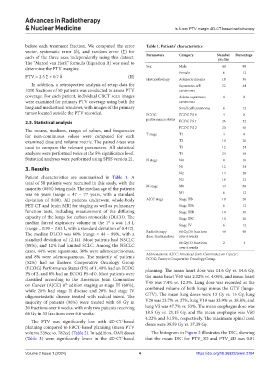
            3. Results                                                       N1                12       24
                                                                             N2                14       28
            Patient characteristics are summarized in  Table 1. A            N3                16       32
            total of 50 patients were recruited in this study, with the
            majority (88%) being male. The median age of the patients   M stage  M0            44       88
            was 66 years (range = 47 – 77 years, with a standard             M1                 6       12
            deviation of  8.00). All patients underwent whole-body   AJCC stage  Stage IIB     10       20
            PET-CT and brain MRI for staging as well as pulmonary            Stage IIIA         6       12
            function tests, including measurement of the diffusing           Stage IIIB        18       36
            capacity of the lungs for carbon monoxide (DLCO). The            Stage IIIC        10       20
                                               st
            median forced expiratory volume in the 1  s was 1.4 L            Stage IV           6       12
            (range = 0.95 – 2.62 L, with a standard deviation of 0.412).
            The median DLCO was 60% (range = 44 – 89%, with a   Radiotherapy   60 Gy/30 fractions   48  96
                                                                             over 6 weeks
                                                               dose-fractionation
            standard deviation of 12.14). Most patients had NSCLC
            (88%), and 12% had limited SCLC. Among the NSCLC                 66 Gy/33 fractions   2      4
                                                                             over 6 weeks
            cases, 44% were squamous, 36% were adenocarcinomas,
            and 8% were adenosquamous. The majority of patients   Abbreviations: AJCC: American Joint Committee on Cancer;
                                                               ECOG: Eastern Cooperative Oncology Group.
            (52%)  had  an  Eastern  Cooperative Oncology  Group
            (ECOG) Performance Status (PS) of 1, 40% had an ECOG   planning. The mean heart dose was 11.6 Gy vs. 14.6 Gy,
            PS of 2, and 8% had an ECOG PS of 0. Most patients were   the mean heart V60 was 2.02% vs. 4.04%, and mean heart
            classified according to the American Joint Committee   V45 was 7.4% vs. 12.3%. Lung dose was recorded as the
            on Cancer (AJCC) 8  edition staging as stage III (60%),
                             th
            while 20% had stage II disease and 20% had stage IV   combined volume of both lungs minus the GTV (lungs-
            oligometastatic disease treated  with radical intent. The   GTV). The mean lung doses were 13 Gy vs. 15 Gy, lung
            majority  of  patients  (96%)  were  treated  with  60  Gy  in   V20 was 23.7% vs. 27%, lung V10 was 33.9% vs. 38.8%, and
            30 fractions over 6 weeks, with only two patients receiving   lung V5 was 47.7% vs. 53%. The mean esophagus dose was
            66 Gy in 33 fractions over 6.6 weeks.              18.5 Gy vs. 21.15 Gy, and the mean esophagus was V60
                                                               4.22% and 5.15%, respectively. The maximum spinal cord
              The PTV was significantly low with 4D-CT-based   doses were 35.59 Gy vs. 37.39 Gy.
            planning compared to FBCT-based planning (mean PTV
            volume 539cc vs. 782cc) (Table 2). In addition, OAR doses   The histogram in Figure 2 illustrates the DIC, showing
            (Table 3) were significantly lower in the 4D-CT-based   that the mean DIC for PTV_3D and PTV_4D was 0.81


            Volume 2 Issue 1 (2024)                         4                       https://doi.org/10.36922/arnm.2784

