


Page 24 - ARNM-2-1
P. 24
Advances in Radiotherapy
            & Nuclear Medicine                                             Is 5-mm PTV margin 4D-CT-based radiotherapy


            mandatory. The maximum intensity projection picture was   (iii) IGTVN_4D versus GTVN_3D: only two datasets with
            used to contour the GTV_4D for primary and/or nodal   gross nodal disease contours.
            illnesses. Phases spanning 0 – 90% of the respiratory cycle   (iv)  PTV_4D and PTV_3D. PTV for two sets of data:
            were separately examined to ensure adequate contouring of   PTVD  95_4D  and  PTVD  95_3D.  In  both  plans,
            IGTV_4D or composite GTV_4D. Subsequently, CTV_4D     95% of the recommended dosage for PTV_3D and
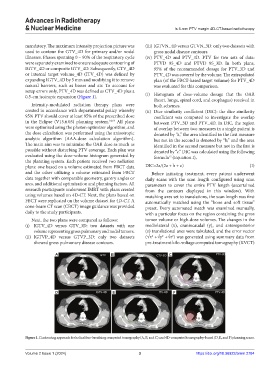
            or internal target volume_4D (ITV_4D) was defined by   PTV_4D was covered by the volume. The extrapolated
            expanding IGTV_4D by 5 mm and modifying it to remove   plan (of the FBCT-based target volume) for PTV_4D
            natural  barriers,  such as bones and air.  To account for   was evaluated for this comparison.
            setup errors only, PTV_4D was defined as CTV_4D plus a
            0.5-cm isotropic expansion (Figure 1).             (i)  Histogram  of  dose-volume dosage  that  the  OAR
                                                                  (heart, lungs, spinal cord, and esophagus) received in
              Intensity-modulated radiation therapy plans were    both schemes.
            created in accordance with departmental policy whereby   (ii)  Dice similarity coefficient (DIC): the dice similarity
            95% PTV should cover at least 95% of the prescribed dose   coefficient was computed to investigate the overlap
            in the Eclipse (V15.6.03) planning system. 18,19  All plans   between PTV_3D and PTV_4D. In DIC, the region
            were optimized using the photon optimizer algorithm, and   of overlap between two measures in a single patient is
            the dose calculation was performed using the anisotropic   denoted by “a,” the area identified in the first measure
            analytic algorithm (AAA-dose calculation algorithm).   but not in the second is denoted by “b,” and the area
            The main aim was to minimize the OAR dose as much as   identified in the second measure but not in the first is
            possible without disturbing PTV coverage. Each plan was   denoted by “c.” DIC was calculated using the following
            evaluated using the dose-volume histogram generated by   formula  (Equation I),
                                                                         12
            the planning system. Each patient received two radiation
            plans: one based on a volume estimated from FBCT data   DIC=2a/(2a + b + c)                    (I)
            and the other  utilizing  a  volume estimated  from  FBCT   Before initiating treatment, every patient underwent
            data together with comparable geometry, gantry angles or   daily scans with the scan length configured using scan
            arcs, and additional optimization and planning factors. All   parameters to cover the entire PTV length (ascertained
            research participants underwent IMRT with plans created   from the contours displayed in this window). With
            using volumes based on 4D-CT. Next, the plans based on   matching axes set to translations, the scan length was first
            FBCT were replicated on the volume dataset for 4D-CT. A   automatically matched using the “bone and soft tissue”
            cone-beam CT scan (CBCT) image guidance was provided   preset. Every automated match was examined manually,
            daily to the study participants.                   with a particular focus on the region containing the gross
              Next, the two plans were compared as follows:    tumor volume or high-dose volumes. The changes in the
            (i)  IGTV_4D  versus GTV_3D:  two datasets with  one   mediolateral (x), craniocaudal (y), and anteroposterior
               volume representing gross pulmonary and nodal tumors.  (z) translational axes were tabulated, and the error vector
            (ii)  IGTVP_4D versus GTVP_3D: only two datasets   (√x  +√y  +√z ) was generated using summary data from
                                                                      2
                                                                  2
                                                                          2
               showed gross pulmonary disease contours.        pre-treatment kilo-voltage computed tomography (KVCT)
                         A                      B                        C


                         D                       E                         F


            Figure 1. Contouring approach for helical free-breathing computed tomography (A, B, and C) and 4D-computed tomography-based (D, E, and F) planning scans.


            Volume 2 Issue 1 (2024)                         3                       https://doi.org/10.36922/arnm.2784

