


Page 53 - ARNM-2-1
P. 53
Advances in Radiotherapy
            & Nuclear Medicine                                             Bone scan image features of secondary syphilis


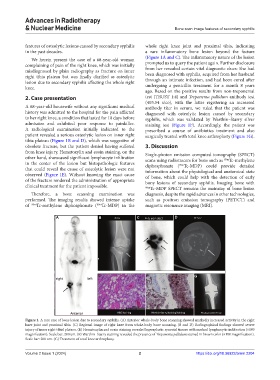
            features of osteolytic lesions caused by secondary syphilis   whole right knee joint and proximal tibia, indicating
            in the past decades.                               a rare inflammatory bone lesion beyond the facture
              We  herein  present  the  case  of  a  68-year-old  woman   (Figure 1A and C). The inflammatory nature of the lesion
            complaining of pain of the right knee, which was initially   prompted us to query the patient again. Further disclosure
            misdiagnosed by plain radiography as fracture on inner   from her revealed certain vital diagnostic clues: She had
            right tibia plateau but was finally clarified as osteolytic   been diagnosed with syphilis, acquired from her husband
            lesion due to secondary syphilis affecting the whole right   through an intimate infection, and had been cured after
            knee.                                              undergoing a penicillin treatment for a month 8  years
                                                               ago. Based on the positive results from non-treponemal
            2. Case presentation                               test (TRUST 1:4) and Treponema pallidum antibody test
                                                               (403.54  s/co), with the latter registering an increased
            A 68-year-old housewife without any significant medical   antibody titer in serum, we ruled that the patient was
            history was admitted to the hospital for the pain afflicted   diagnosed with osteolytic lesion caused by secondary
            to her right knee, a condition that lasted for 10 days before   syphilis, which was validated by Warthin–Starry silver
            admission and exhibited poor response to painkiller.   staining  test  (Figure  1F).  Accordingly,  the  patient  was
            A  radiological examination initially indicated to the   prescribed a course of antibiotics treatment and also
            patient revealed a serious osteolytic lesion on inner right   surgically treated with total knee arthroplasty (Figure 1G).
            tibia plateau (Figure 1B and D), which was suggestive of
            obsolete fracture, but the patient denied having suffered   3. Discussion
            from knee injury. Hematoxylin and eosin staining, on the   Single-photon emission computed  tomography (SPECT)
            other hand, showcased significant lymphocyte infiltration   scans using radiotracers for bone such as  99m Tc-methylene
            in  the center  of the lesion but  histopathologic features   diphosphonate ( Tc-MDP) could provide detailed
                                                                             99m
            that  could  reveal  the  cause  of  osteolytic  lesion  were  not   information about the physiological and anatomical state
            observed (Figure  1E). Without knowing the exact cause   of bone, which could help with the detection of early
            of the fracture rendered the administration of appropriate   bony lesions of secondary syphilis. Imaging bone with
            clinical treatment for the patient impossible.     99m Tc-MDP SPECT remains the mainstay of bone lesion
              Therefore, a bone scanning examination was       diagnosis, despite the rapid advances in other technologies,
            performed. The imaging results showed intense uptake   such  as  positron  emission  tomography  (PET/CT)  and
            of   99m Tc-methylene diphosphonate ( Tc-MDP) in the   magnetic resonance imaging (MRI).
                                          99m
                         A                 B               C               D


                                           E                   F                    G


            Figure 1. A rare case of bone lesion due to secondary syphilis. (A) Anterior whole-body bone scanning showed markedly increased activity in the right
            knee joint and proximal tibia. (C) Regional image of right knee from whole-body bone scanning. (B and D) Radiographical findings showed severe
            injury of inner right tibial plateau. (E) Hematoxylin and eosin staining revealed hyperplastic synovial tissues with marked lymphocytic infiltration (×100
            magnification). Scale bar: 200 um. (F) Warthin–Starry staining revealed the presence of Treponema pallidum stained in brown color (×100 magnification).
            Scale bar: 200 um. (G) Treatment of total knee arthroplasty.


            Volume 2 Issue 1 (2024)                         2                       https://doi.org/10.36922/arnm.2204

