


Page 49 - ARNM-2-1
P. 49
Advances in Radiotherapy
            & Nuclear Medicine                                                                   SRS after WBRT


            significant predictors of survival (P < 0.0007 and P < 0.011,   developed distant brain failure, while the rest (six patients)
            respectively). Patients with breast cancer had increased   with 3 months of follow-up and no distant brain relapse
            median survival time of 289 days (9.6 months) compared   developed brain metastases (9 metastases in one patient,
            to patients with SCLC with a median survival of 127 days   5 in one, 2 in one, and 1 in three).
            (4.2 months). We found that patients who had more than   Local failure was a rare event. Five local failure cases
            2 metastases had a decreased survival time compared to   were reported, with a median time to local failure of
            patients who had 1 to 2 metastases (P < 0.001). Patients with   766 days. Patients with local failure had a median interval
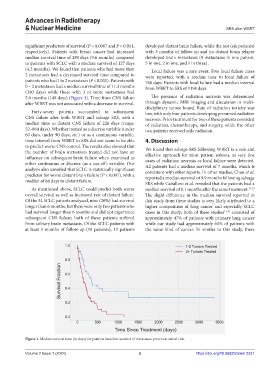
            0 – 2 metastases had a median survival time of 11.3 months   from WBRT to SRS of 1198 days.
            (340  days) while those with 3 or more metastases had
            5.0 months (149 days) (Figure 1). Time from CNS failure   The presence of radiation necrosis was determined
            after WBRT was not associated with a decrease in survival.  through dynamic MRI imaging and discussion in multi-
                                                               disciplinary  tumor  board.  Rate  of  radiation  toxicity  was
              Forty-seven patients succumbed to subsequent     low, with only four patients developing presumed radiation
            CNS failure after  both WBRT and  salvage SRS,  with a   necrosis. Prior treatment for two of these patients consisted
            median time to distant CNS failure of 226  days (range:   of radiation, chemotherapy, and surgery, while the other
            22–864 days). Whether treated as a discrete variable (under   two patients received only radiation.
            60 days, under 90 days, etc.) or as a continuous variable,
            time interval from WBRT to SRS did not seem to be able   4. Discussion
            to predict worse CNS control. The results also showed that   We found that salvage SRS following WBRT is a safe and
            the number of brain metastases treated did not have an
            influence on subsequent brain failure when examined as   effective approach for most patient subsets, as very few
                                                               cases of radiation necrosis or local failure were detected.
            either continuous or discrete (as a cut-off) variable. Our   All patients had a median survival of 7 months, which is
            analysis also unveiled that SCLC is statistically significant   consistent with other reports. In other studies, Chao et al.
            predictor for worse distant brain failure (P < 0.007), with a   reported a median survival of 9.9 months following salvage
            median of 88 days to distant failure.              SRS while Caballero et al. revealed that the patients had a
              As mentioned above, SCLC could predict both worse   median survival of 8.1 months after the same treatment. 11,13
            overall survival as well as increased rate of distant failure.   The slight difference in the median survival reported in
            Of the 34 SCLC patients analyzed, nine (26%) had survival   this study from these studies is very likely attributed to a
            longer than 6 months, but there were only two patients who   higher composition of lung cancer and especially SCLC
            had survival longer than 6 months and did not experience   cases in this study; both of these studies 11,13  consisted of
            subsequent CNS failure; both of these patients suffered   approximately 47% of patients with primary lung cancer
            from solitary brain metastasis. Of the SCLC patients with   while our study had approximately 60% of patients with
            at least 3 months of follow-up (18 patients), 12 patients   the same kind of cancer. In similar to this study, there


            Figure 1. Median survival time (in days) for patients based on number of metastases present at initial visit.


            Volume 2 Issue 1 (2024)                         3                       https://doi.org/10.36922/arnm.2231

