


Page 48 - ARNM-2-1
P. 48
Advances in Radiotherapy
            & Nuclear Medicine                                                                   SRS after WBRT


            be potentially brought down through improved systemic   at a multi-disciplinary neuro-oncology clinic until the
            control using new agents such as immunotherapy. 2,4,6,9,10  3  year, under the assumption that scans are normal.  If
                                                                                                          12
                                                                rd
              Patients with intracranial progression after WBRT   suspected of having recurrence versus radiation necrosis,
            present  a therapeutic  dilemma. The radiation options   asymptomatic  patients  are  started  on  pentoxifylline
            include repeat WBRT or salvage SRS. Several studies   (Trental) and vitamin E with repeat scans performed in
            reported that repeat WBRT led to a survival time of   8 weeks. If the abnormality persists, patients are indicated
            around 4 months.  A limited number of studies focusing   for dynamic MRI imaging consisting of MRI spectroscopy
                          2,10
                                                               and MRI perfusion  to determine whether radiation
            on salvage SRS after WBRT failure found SRS a safe and   necrosis or disease progression is the cause, and biopsy
            effective treatment contributing to a survival time of   will be performed if feasible. Cases are often presented in
            between 8 and 9 months. 11,12
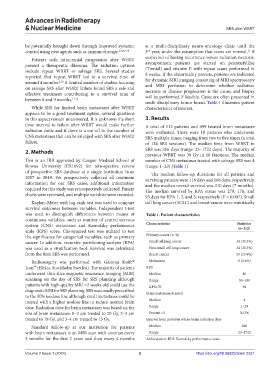
                                                               multi-disciplinary tumor board. Table 1 illustrates patient
              While SRS for limited brain metastases after  WBRT   characteristics of interest.
            appears to be a good treatment option, several questions
            in this aspect remain unanswered. It is unknown if a short   3. Results
            time interval to failure after WBRT would make further   A total of 112 patients and 699 treated brain metastases
            radiation futile and if there is a cut-off in the number of   were evaluated. There were 18  patients who underwent
            CNS metastases that can be salvaged with SRS after WBRT   SRS multiple times, ranging from two to five times (a total
            failure.                                           of 134 SRS sessions). The median time from WBRT to
            2. Methods                                         SRS was 266 days (range: 23–1722 days). The majority of
                                                               previous WBRT was 30 Gy in 10 fractions. The median
            This is an IRB approved by Cooper Medical School of   number of CNS metastases treated with salvage SRS was 4
            Rowan University (EX1092) for retrospective review   (range: 1–29) (Table 1).
            of prospective SRS database at a single institution from   The median follow-up durations for all patients and
            2007  to  2019. We prospectively collected all treatment   surviving patients were 116 days and 168 days, respectively,
            information  for our  SRS cases; additional  information   and the median overall survival was 210 days (7 months).
            required for this study was retrospectively collected. Patient   The median survival by RPA status was 279, 176, and
            charts were reviewed, and multiple variables were recorded.  95 days for RPA 1, 2, and 3, respectively (P < 0.007). Small
              Kaplan–Meier with log-rank test was used to compare   cell lung cancer (SCLC) and breast cancer were statistically
            survival outcomes between variables. Independent  t-test
            was used to distinguish differences between means of   Table 1. Patient characteristics
            continuous variables, such as number of central nervous
            system (CNS) metastases and Karnofsky performance   Characteristics                       Statistics
                                                                                                      (n=112)
            scale (KPS) score. Chi-squared test was utilized to test
            the significance for categorical variables, such as primary   Primary cancer (n, %)
            cancer. In addition, recursive partitioning analysis (RPA)   Small cell lung cancer       34 (30.3%)
            was used as a stratification tool. Survival was calculated   Non-small cell lung cancer   34 (30.3%)
            from the time SRS was performed.                    Breast cancer                         29 (25.9%)
              Radiosurgery was performed with Gamma Knife       Melanoma                              6 (5.4%)
                                                         ®
            Icon  (Elekta, Stockholm Sweden). The majority of patients   KPS
               ™
            underwent thin-slice magnetic resonance imaging (MRI)   Median                              80
            scanning on the day of SRS for SRS planning although   Range                               50–100
            patients with high-quality MRI <2 weeks old could use the   KPS≥70                          94
            diagnostic MRI for SRS planning. SRS was usually prescribed   Brain metastases treated
            to the 50% isodose line although small metastases could be
            treated with a higher isodose line to reduce normal brain   Median                           4
            dose. Radiation dose for brain metastases was based on the   Range                         1–29
            size of brain metastases: 0–2 cm treated to 20 Gy, 2–3 cm   Percent >5                     30.3%
            treated to 18 Gy, and 3–4 cm treated to 15 Gy.     Interval from previous whole-brain radiation days
              Standard follow-up at our institution for patients   Median                               266
            with brain metastases is an MRI scan with contrast every   Range                          23–1722
            3  months for the first 2  years and then every 4  months   Abbreviation: KPS: Karnofsky performance scale.


            Volume 2 Issue 1 (2024)                         2                       https://doi.org/10.36922/arnm.2231

