


Page 44 - ARNM-2-1
P. 44
Advances in Radiotherapy
            & Nuclear Medicine                                          Exploring  F-FDG PET/CT in Richter transformation
                                                                               18


            Table 2. Percentage of increased  F‑FDG uptake in lymph   Table 4. Summary of PET/CT predictive values for detecting
                                     18
            node areas                                         RT nodes % of increased uptake
            Lymph nodes    Percentage of increased  F‑FDG uptake (%)  Study  RT   SUVmax Specificity  Predictive value (%)
                                           18
            Cervical                     28.5                             cases          (%)   Positive  Negative
            Inguinal                     28.5                  Bruzzi et al. 3  10  5    80      53     97
            Axillary                     14                    Mauro et al. 4  17  5    71.2    51.3    94
            Lung hilar                   14                    Falchi et al. 12  95  5   47      38     92
            Lombo-aortic                 14                    Abbreviations: PET/CT: Positron emission tomography-computed
            Other                         1                    tomography; RT: Richter transformation; SUVmax: Standardized
                                                               uptake value.
            Abbreviation: FDG: Fluorodeoxyglucose.
                                                               A                     B
            Table 3. Predictive value of PET/CT for detecting RT in 12
            patients
            Parameters                              Value
            PET value (number of patients)
             Positive                                 4
             Negative                                 8
            Predictive values (%)
             Positive                                37.5
             Negative                                100
            Specificity (%)                          44.5
            False positive (%)                       62.5
            Nodal sites (%)
             Nodal and extranodal sites              37.5
             Only nodal sites                        62.5      Figure  1.  Images of a 53-year-old female CLL patient. (A) MIP and
            Positive biopsy at nodal sites (%)                 (B) fusion images of the patient’s coronal section. The images displayed
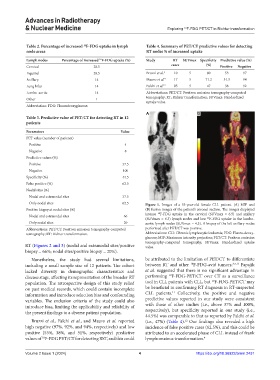
                                                               intense  F-FDG  uptake in  the cervical (SUVmax = 6.5)  and axillary
                                                                    18
             Nodal and extranodal sites               66
                                                               (SUVmax = 6.3) lymph nodes and low  F-FDG uptake in the lombo-
                                                                                         18
             Only nodal sites                         20       aortic lymph nodes (SUVmax = 4.3). A biopsy of the left axillary nodes
            Abbreviations: PET/CT: Positron emission tomography-computed   performed after PET/CT was positive.
            tomography; RT: Richter transformation.            Abbreviations: CLL: Chronic lymphocytic leukemia; FDG: Fluoro-deoxy-
                                                               glucose; MIP: Maximum intensity projection; PET/CT: Positron emission
                                                               tomography-computed tomography; SUVmax:  Standardized uptake
            RT (Figures 2 and 3) (nodal and extranodal sites/positive   value.
            biopsy = 66%; nodal sites/positive biopsy = 20%).
              Nonetheless, the study had several limitations,   be attributed to the limitation of PET/CT to differentiate
                                                                                  18
            including a small sample size of 12 patients. The cohort   between RT and other  F-FDG-avid tumors. 3,4,12  Papajik
            lacked diversity in demographic characteristics and   et al. suggested that there is no significant advantage in
                                                                         18
            disease stage, affecting its representation of the broader RT   performing  F-FDG-PET/CT over CT as a surveillance
                                                                                           18
            population. The retrospective design of this study relied   tool in CLL patients with CLL, but  F-FDG-PET/CT may
            on past medical records, which could contain incomplete   be beneficial in confirming RT diagnosis in RT-suspected
                                                                          11
            information and introduce selection bias and confounding   CLL patients.  Collectively, the positive and negative
            variables. The exclusion criteria of the study could also   predictive values reported in our study were consistent
            introduce bias, limiting the applicability and reliability of   with those of other studies (i.e., above 37% and 100%,
            the present findings to a diverse patient population.  respectively), but specificity reported in our study (i.e.,
                                                               44.5%) was comparable to that as reported by Falchi et al.
              Bruzzi  et al., Falchi  et al., and Mauro  et al. reported   (i.e., 47%) (Table 4).  Our findings also revealed a high
                                                                                12
            high negative (97%, 92%, and 94%, respectively) and low   incidence of false positive cases (62.5%), and this could be
            positive (53%,  38%, and  51%, respectively)  predictive   attributed to an accelerated phase of CLL instead of frank
            values of  F-FDG PET/CT for detecting RST, and this could   lymphomatous transformation. 4
                   18

            Volume 2 Issue 1 (2024)                         4                       https://doi.org/10.36922/arnm.2431

