


Page 24 - ARNM-2-2
P. 24
Advances in Radiotherapy
            & Nuclear Medicine                                                     Melanoma brain metastatic treatment


            Table 1. (Continued)
            Author (year)  Number    Number    Strategies    Treatment      Main results      Main conclusions
                         of studies   of patients   included in the   arms
                         included    included  analyses
                         studies, and                                   alone (HR=0.595,    significantly increase
                         1 phase I                                      95% CI: 0.489 – 0.723,   grade 3 – 4 neurological
                         study)                                         P < 0.001           adverse events.
                                                                        Grade ≥3 neurologic   ICI+RT did not
                                                                        adverse events for ICI+RT   significantly increase
                                                                        versus RT alone (RR=1.425,   grade ≥3 radiation
                                                                        95% CI: 0.485 – 4.183,   necrosis.
                                                                        P=0.519)
                                                                        Grade ≥ 3 radiation
                                                                        necrosis for ICI+RT versus
                                                                        RT alone (RR=2.73 [95%
                                                                        CI: 0.59 – 12.59; P=0.199])
            Su et al. 28  11 studies  4154 (98%   RT (WBRT or   SRS+ICI   OS of SRS+ICI group longer   ICI alone showed a higher
                                     melanoma   SRS)         versus ICI   than that of ICI group  OS benefit in BM patients
                                     patients)  ICI (ipilimumab/  alone  (HR=1.72,          than targeted therapy
                                               prembrolizumab/  ICI versus   95% CI: 1.41 – 2.11, P=0.22)  alone.
                                               nivolumab)    TT         OS of ICI group longer   Total survival time of
                                               TT (BRAF or              than that of non-ICI group   patients with SRS+ICI
                                               MEK inhibitors)          (HR=7.78,           was longer than that of
                                                                        95% CI: 6.85 – 8.83)  patients with single ICI.
            Badrigilan et al. 32  16   1465 (only   RT (SRS)  SRS alone   OS for ICI versus no-ICI   SRS+ICI improves
                         retrospective   melanoma in   ICI (ipilimumab/  versus   (HR=0.66,   patients’ clinical and
                         studies     13 studies)  prembrolizumab/  ICI+SRS   95% CI: 0.55 – 0.8)  radiological outcomes.
                                               nivolumab)    (either    OS for concurrent therapy   The effectiveness of the
                                                             concurrently   versus non-concurrent   combination is subject
                                                             or non-    therapy (HR=1.43, P=0.008)   to the identification of
                                                             concurrently,   and 1-year LBC (HR =1.91,   an optimal therapeutic
                                                             or ICI before   P=0.04)        window
                                                             SRS or ICI   OS for concurrent therapy
                                                             after SRS)  versus ICI before SRS
                                                                        (HR=2.55, P=0.0003)
            Abbreviations: BM: Brain metastases; CI: Confident interval; DCR: Disease control rate; HR: Hazard ratio; RR: Risk ratio; ICI: Immune checkpoint
            inhibitor; LBC: Local brain control; LC: Local control; ORR: Overall response rate; OS: Overall survival; RT: Radiotherapy; SRS: Stereotactic
            radiosurgery; TT: Target therapy; WBRT: Whole brain radiotherapy.

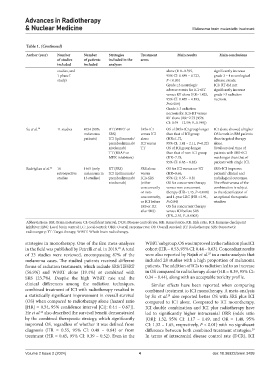
            strategies in monotherapy. One of the first meta-analyses   WBRT subgroup, OS was improved in the radiation plus ICI
            in the field was published by Petrelli et al. in 2019.  A total   cohort (HR = 0.53, 95% CI: 0.44 – 0.63). Concordant results
                                                   25
                                                                                          27
            of  33 studies  were  reviewed,  encompassing 87%  of  the   were also reported by Najafi et al.  in a meta-analysis that
            melanoma cases. The studied patients received different   included 28 studies with a high proportion of melanoma
            forms of radiation treatments, which include SRS/HFSRT   patients. The addition of ICIs to radiation led to an increase
            (56.9%) and WBRT alone (19.4%) or combined with    in OS compared to radiotherapy alone (HR = 0.39, 95% CI:
            SRS (23.7%). Despite the high WBRT rate and the    0.34 – 0.44), along with an acceptable toxicity profile.
            clinical differences among the radiation techniques,   Similar effects have been reported when comparing
            combined treatment of ICI with radiotherapy resulted in   combined treatment to ICI monotherapy. A meta-analysis
            a statistically significant improvement in overall survival   by Su et al.  also reported better OS with SRS plus ICI
                                                                        28
            (OS) when compared to radiotherapy alone (hazard ratio   compared to ICI alone. Compared to ICI monotherapy,
            [HR] = 0.54, 95% confidence interval [CI]: 0.44 – 0.67]).   ICI double combination and ICI plus radiotherapy have
            He et al.  also described the survival benefit demonstrated   led to significantly higher intracranial ORR (odds ratio
                  26
            by the combined therapeutic strategy, which significantly   [OR]: 1.32, 95% CI: 1.17 – 1.49, and OR = 1.48, 95%
            improved OS, regardless of whether it was defined from   CI: 1.32 – 1.65, respectively, P < 0.01) with no significant
            diagnosis (HR = 0.55, 95% CI: 0.48 – 0.64) or from   difference between both combined treatment strategies.
                                                                                                            29
            treatment (HR = 0.45, 95% CI: 0.39 – 0.52). Even in the   In terms of intracranial disease control rate (DCR), ICI


            Volume 2 Issue 2 (2024)                         4                              doi: 10.36922/arnm.3499

