


Page 76 - ARNM-2-2
P. 76
Advances in Radiotherapy
            & Nuclear Medicine                                                     Wound reconstruction with Intergra®


                         A                       B                       C


                         D                       E                       F


                         G                       H                       I


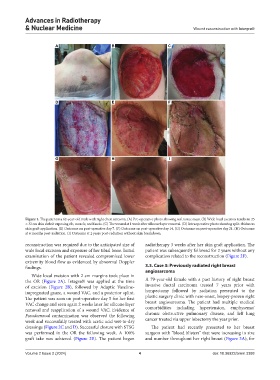
            Figure 1. The patient is a 62-year-old male with right chest sarcoma. (A) Pre-operative photo showing soft tissue mass. (B) Wide local excision results in 25
            × 32 cm skin deficit exposing rib, muscle, and fascia. (C) The wound at 1 week after silicone layer removal. (D) Intraoperative photo showing split-thickness
            skin graft application. (E) Outcome on post-operative day 7. (F) Outcome on post-operative day 14. (G) Outcome on post-operative day 21. (H) Outcome
            at 6 months post-radiation. (I) Outcome at 2 years post-radiation without skin breakdown.

            reconstruction was required due to the anticipated size of   radiotherapy 3 weeks after her skin graft application. The
            wide local excision and exposure of her tibial bone. Initial   patient was subsequently followed for 2 years without any
            examination of the patient revealed compromised lower   complication related to the reconstruction (Figure 2F).
            extremity blood flow as evidenced by abnormal Doppler
            findings.                                          3.3. Case 3: Previously radiated right breast
                                                               angiosarcoma
              Wide local excision with 2 cm margins took place in
            the OR (Figure  2A). Integra® was applied at the time   A 79-year-old female with a past history of right breast
            of excision (Figure  2B), followed by Adaptic Vaseline-  invasive ductal carcinoma treated 7  years prior with
            impregnated gauze, a wound VAC, and a posterior splint.   lumpectomy  followed by  radiation  presented to  the
            The patient was seen on post-operative day 5 for her first   plastic surgery clinic with new-onset, biopsy-proven right
            VAC change and seen again 2 weeks later for silicone layer   breast angiosarcoma. The patient had multiple medical
            removal and reapplication of a wound VAC. Evidence of   comorbidities  including  hypertension,  emphysema/
            Pseudomonal  contamination  was  observed  the  following   chronic obstructive pulmonary disease, and left lung
            week and successfully treated with acetic acid wet-to-dry   cancer treated via upper lobectomy the year prior.
            dressings (Figure 2C and D). Successful closure with STSG   The patient had recently presented to her breast
            was performed in the OR the following week. A  100%   surgeon with “blood blisters” that were increasing in size
            graft take was achieved (Figure  2E). The patient began   and number throughout her right breast (Figure 3A), for


            Volume 2 Issue 2 (2024)                         4                              doi: 10.36922/arnm.3388

