


Page 74 - ARNM-2-2
P. 74
Advances in Radiotherapy
            & Nuclear Medicine                                                     Wound reconstruction with Intergra®


            proliferative capacity of surviving cells, decreased   Herein, we present a case series of four patients who
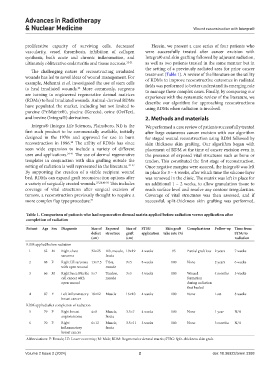
            vascularity, vessel thrombosis, inhibition of collagen   were successfully treated after cancer excision with
            synthesis, both acute and  chronic  inflammation, and   Integra® and skin grafting followed by adjuvant radiation,
            ultimately obliterative endarteritis and tissue necrosis. 12-21  as well as two patients treated in the same manner but in
                                                               the setting of a previously radiated area for prior cancer
              The challenging nature of reconstructing irradiated
            wounds has led to novel ideas of wound management. For   treatment (Table 1). A review of the literature on the utility
                                                               of RDMs to improve reconstructive outcomes in radiated
            example, Mehanni et al. investigated the use of stem cells   fields was performed to better understand its emerging role
            to heal irradiated wounds.  More commonly, surgeons   to manage these complex cases. Finally, by comparing our
                                  22
            are turning to engineered regenerative dermal matrices   experience with the systematic review of the literature, we
            (RDMs) to heal irradiated wounds. Animal-derived RDMs   describe our algorithm for approaching reconstructions
            have populated the market, including but not limited to   using RDMs when radiation is involved.
            porcine (PriMatrix®), piscine (Kerecis), ovine (OviTex),
            and bovine (Integra®) derivatives.                 2. Methods and materials

              Integra® (Integra Life Sciences, Plainsboro, NJ) is the   We performed a case review of patients successfully treated
            first such product to be commercially available, initially   after large cutaneous cancer excision with our algorithm
            designed  in  the  1970s  and  approved  for  use  in  burn   for staged wound reconstruction using RDM followed by
            reconstruction in 1996.  The utility of RDMs has since   skin thickness skin grafting. Our algorithm began with
                               23
            seen wide expansion to include a variety of different   placement of RDM at the time of cancer excision even in
            uses and applications. 24-41  The use of dermal regenerative   the presence of exposed vital structures such as bone or
            templates in conjunction with skin grafting outside the   tendon. This constituted the first stage of reconstruction.
            setting of radiation is well represented in the literature. 42-47    Once negative margins were assured, the Integra® was left
            By supporting the creation of a viable recipient wound   in place for 3 – 4 weeks, after which time the silicone layer
            bed, RDMs can expand graft reconstruction options after   was removed in the clinic. The matrix was left in place for
            a variety of surgically created wounds. 27,28,48-50  This includes   an additional 1 – 2 weeks, to allow granulation tissue to
            coverage of vital structures after surgical excision of   reach surface level and resolve any contour irregularities.
            tumors, a reconstruction previously thought to require a   Coverage of vital structures was then assessed, and if
            more complex flap type procedure. 51               successful, split-thickness skin grafting was performed.


            Table 1. Comparison of patients who had regenerative dermal matrix applied before radiation versus application after
            completion of radiation
            Patient  Age Sex  Diagnosis  Size of  Exposed   Size of   STSG   Skin graft   Complications  Follow‑up  Time from
                                        defect   structure  graft   application  take rate (%)       STSG to
                                        (cm)           (cm)                                          radiation
            RDM applied before radiation
             1      62  M  Right chest   32×25  Rib, muscle,  19×19  4 weeks  95  Partial graft loss 2 years  7 weeks
                           sarcoma            fascia
             2      88  F  Right LE sarcoma  13×7.5  Tibia,   9×5  8 weeks  100  None       2 years  6 weeks
                           with open wound    muscle
             3      66  M  Right knee Merkle  5×7  Tendon,   3×5  4 weeks  100   Wound      4 months  5 weeks
                           cell cancer with   muscle                             formation
                           open wound                                            during radiation
                                                                                 that healed
             4      87  F  Left inflammatory  18×12  Muscle  16×10  4 weeks  100  None      Lost     8 weeks
                           breast cancer
            RDM applied after completion of radiation
             5      79  F  Right breast   4×8  Muscle,   3.5×7  4 weeks   100    None       1 year   N/A
                           angiosarcoma       fascia
             6      70  F  Right        6×12  Muscle,   3.5×11  5 weeks   100    None       3 months  N/A
                           inflammatory       fascia
                           breast cancer
            Abbreviations: F: Female; LE: Lower extremity; M: Male; RDM: Regenerative dermal matrix; STSG: Split-thickness skin graft.


            Volume 2 Issue 2 (2024)                         2                              doi: 10.36922/arnm.3388

