


Page 70 - ARNM-2-2
P. 70
Advances in Radiotherapy
            & Nuclear Medicine                                                       18 F-FDG PET/CT in LVAD infection


            A


            B


            C


            D


            E


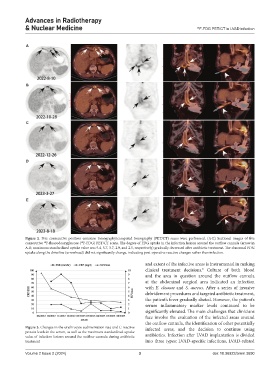
            Figure  2. Five consecutive positron emission tomography/computed tomography (PET/CT) scans were performed. (A-E) Sectional images of five
            consecutive  F-fluorodeoxyglucose ( F-FDG) PET/CT scans. The degree of FDG uptake in the infection lesions around the outflow cannula (arrow in
                                   18
                    18
            A-E; maximum standardized uptake value was 9.4, 5.7, 3.7, 2.9, and 2.5, respectively) gradually decreased after antibiotic treatment. The abnormal FDG
            uptake along the driveline (arrowhead) did not significantly change, indicating post-operative reactive changes rather than infection.
                                                               and extent of the infective areas is instrumental in making
                                                               clinical treatment decisions.  Culture of both blood
                                                                                       9
                                                               and the area in question around the outflow cannula
                                                               at the abdominal surgical area indicated an infection
                                                               with  E.  cloacae  and  S. aureus. After a series of invasive
                                                               debridement procedures and targeted antibiotic treatment,
                                                               the patient’s fever gradually abated. However, the patient’s
                                                               serum inflammatory marker levels continued to be
                                                               significantly elevated. The main challenges that clinicians
                                                               face involve the evaluation of the infected areas around
                                                               the outflow cannula, the identification of other potentially
            Figure 3. Changes in the erythrocyte sedimentation rate and C-reactive   infected areas, and the decision to continue using
            protein levels in the serum, as well as the maximum standardized uptake
            value of infection lesions around the outflow cannula during antibiotic   antibiotics. Infection after LVAD implantation is divided
            treatment                                          into three types: LVAD-specific infections, LVAD-related

            Volume 2 Issue 2 (2024)                         3                              doi: 10.36922/arnm.3690

