


Page 69 - ARNM-2-2
P. 69
Advances in Radiotherapy
            & Nuclear Medicine                                                       18 F-FDG PET/CT in LVAD infection


            ( F-FDG PET/CT).  FDG PET/CT has an incremental    patient’s body temperature gradually returned to normal.
                            4-7
            18
            role in technically limited or inconclusive cases of computed   However, the levels of inflammatory markers, such as
            tomography (CT) or echocardiography.  Occasionally, it   the erythrocyte sedimentation rate (ESR) and C-reactive
                                            8
            is difficult to distinguish high fluorodeoxyglucose (FDG)   protein (CRP) levels, remained abnormal. The patient was
            uptake lesions caused by infection and those resulting   referred to the nuclear medicine department for PET/CT
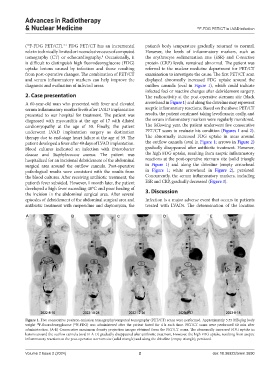
            from post-operative changes. The combination of PET/CT   examination to investigate the cause. The first PET/CT scan
            and serum inflammatory markers can help improve the   displayed abnormally increased FDG uptake around the
            diagnosis and evaluation of infected areas.        outflow cannula (oval in  Figure  1), which could indicate
                                                               infected foci or reactive changes after debridement surgery.
            2. Case presentation                               The radioactivity at the post-operative sternum site (black

            A 60-year-old man who presented with fever and elevated   arrowhead in Figure 1) and along the driveline may represent
            serum inflammatory marker levels after LVAD implantation   aseptic inflammatory reactions. Based on the above PET/CT
            presented to our hospital for treatment. The patient was   results, the patient continued taking levofloxacin orally, and
            diagnosed with myocarditis at the age of 17 with dilated   the serum inflammatory markers were regularly monitored.
            cardiomyopathy at the age of 50. Finally, the patient   The following year, the patient underwent five consecutive
            underwent  LVAD  implantation  surgery  as  destination   PET/CT scans to evaluate his condition (Figures 1 and 2).
            therapy due to end-stage heart failure at the age of 59. The   The abnormally increased FDG uptake in areas around
            patient developed a fever after 49 days of LVAD implantation.   the outflow cannula (oval in Figure 1; arrows in Figure 2)
            Blood  cultures indicated an  infection with  Enterobacter   gradually  disappeared  after  antibiotic  treatment.  However,
            cloacae and Staphylococcus aureus. The patient was   the high FDG uptake, resulting from aseptic inflammatory
            hospitalized for an incisional debridement of the abdominal   reactions at the post-operative sternum site (solid triangle
            surgical area around the outflow cannula. Post-operative   in  Figure  1) and along the driveline (empty arrowhead
            pathological results were consistent with the results from   in  Figure  1; white arrowhead in  Figure  2), persisted.
            the blood cultures. After receiving antibiotic treatment, the   Concurrently, the serum inflammatory markers, including
            patient’s fever subsided. However, 1 month later, the patient   ESR and CRP, gradually decreased (Figure 3).
            developed a high fever exceeding 40°C and poor healing of   3. Discussion
            the incision in the abdominal surgical area. After several
            episodes of debridement of the abdominal surgical area and   Infection is a major adverse event that occurs in patients
            antibiotic treatment with meperidine and daptomycin, the   treated with LVADs. The determination of the location

            A                  B                   C                  D                   E


            Figure 1. Five consecutive positron emission tomography/computed tomography (PET/CT) scans were performed. Approximately 5.55 MBq/kg body
            weight  F-fluorodeoxyglucose ( F-FDG) was administered after the patient fasted for 4  h each time. PET/CT scans were performed 60  min after
                 18
                                 18
            administration. (A-E) Consecutive maximum density projection images obtained from the PET/CT scans. The abnormally increased FDG uptake in
            lesions around the outflow cannula (oval in A-D) gradually disappeared after antibiotic treatment. However, the high FDG uptake, resulting from aseptic
            inflammatory reactions at the post-operative sternum site (solid triangle) and along the driveline (empty triangle), persisted.
            Volume 2 Issue 2 (2024)                         2                              doi: 10.36922/arnm.3690

