


Page 64 - ARNM-2-2
P. 64
Advances in Radiotherapy
            & Nuclear Medicine                                                     Optimal tube voltage for dental CBCT


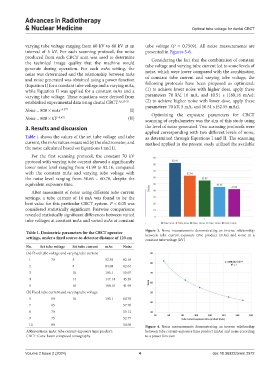
            varying tube voltage ranging from 60 kV to 80 kV at an   tube voltage (P = 0.7509). All noise measurements are
            interval of 5  kV. For each scanning protocol, the noise   presented in Figures 3-6.
            produced from each CBCT scan was used to determine   Considering the fact that the combination of constant
            the technical image quality that the machine would   tube voltage and varying tube current led to some levels of
            generate during operation. For each mAs setting, the   noise, which were lower compared with the combination
            noise was determined and the relationship between mAs
            and noise generated was obtained using a power function   of  constant tube  current  and varying tube voltage, the
            (Equation I) for a constant tube voltage and a varying mAs,   following protocols have been proposed as optimized:
            while Equation II was applied for a constant mAs and a   (1) to achieve lower noise with higher dose, apply these
            varying tube voltage. These equations were derived from   parameters 70  kV, 16  mA, and 10.51 s (168.16 mAs);
            established experimental data using dental CBCT. 4,6,23-25  (2) to achieve higher noise with lower dose, apply these
                                                               parameters: 70 kV, 5 mA, and 10.51 s (52.55 mAs).
            Noise = 808 × mAs −0.577                    (I)
                                                                 Optimizing the exposure parameters for CBCT
            Noise = 808 × kV −0.632                    (II)    scanning of cephalometry was the aim of this study using
            3. Results and discussion                          the level of noise generated. Two scanning protocols were
                                                               applied corresponding with two different levels of noise,
            Table 1 shows the values of the set tube voltage and tube   as determined through Equations I and II. The scanning
            current, the mAs values measured by the electrometer, and   method applied in the present study utilized the available
            the noise calculated based on Equations I and II.

              For the first scanning protocol, the constant 70  kV
            protocol with varying tube current showed a significantly
            lower noise level ranging from 41.99 to 82.16, compared
            with the constant mAs and varying tube voltage with
            the  noise  level  ranging  from  50.66  –  60.76,  despite  the
            equivalent exposure time.
              After assessment of noise using different tube current
            settings, a tube current of 16  mA was found to be the
            best value for this particular CBCT system. P < 0.05 was
            considered statistically significant. Pairwise comparisons
            revealed statistically significant differences between varied
            tube voltages at constant mAs and varied mAs at constant

            Table 1. Dosimetric parameters for the CBCT operator   Figure  3. Noise measurements demonstrating an inverse relationship
            settings, under a fixed source-to-detector distance of 120 cm  between  tube  current-exposure  time  product  (mAs)  and  noise  at  a
                                                               constant tube voltage (kV)
            No.   Set tube voltage  Set tube current  mAs  Noise
            (A) Fixed tube voltage and varying tube current
             1         70       5             52.55  82.16
             2                  8             84.08  62.64
             3                  10            105.1  55.07
             4                  14            147.14  45.36
             5                  16            168.16  41.99
            (B) Fixed tube current and varying tube voltage
             6         60       10            105.1  60.76
             7         65                            57.76
             8         70                            55.12
             9         75                            52.77
             10        80                            50.66
                                                               Figure  4. Noise measurements demonstrating an inverse relationship
            Abbreviations: mAs: tube current-exposure time product;   between tube current-exposure time product (mAs) and noise according
            CBCT: Cone-beam computed tomography.               to a power function


            Volume 2 Issue 2 (2024)                         4                              doi: 10.36922/arnm.2972

