


Page 63 - ARNM-2-2
P. 63
Advances in Radiotherapy
            & Nuclear Medicine                                                     Optimal tube voltage for dental CBCT


            2. Materials and methods                             The  RaySafe  Xi  multimeter  has  a  built-in  sensor
                                                               (internal silicon detector) for measurements of a wide range
            2.1. DAP meter                                     of parameters such as tube current (mA, mAs, waveform),
            This prospective research used a DAP meter to achieve   exposure time, pulses, pulse rate, and tube voltage (kVp).
            direct comparability and to prevent patient radiation in an   Besides, it can also be used as a dosimeter to measure the
            experimental setting. The scan was done using the Planmeca   dose, dose rate, dose-area product (DAP), and half-value
            ProMax 3D Mid CBCT unit (Planmeca, Helsinki, Finland)   layer all at the same time with a single exposure setting. 22
            at Advanced Medical and Dental Institute, Universiti Sains   The instrument is controlled by two buttons: the On/Off
            Malaysia. The device provides a manual selection of scan   buttons and the arrow button for scrolling the measured
            parameters for every scan.                         data. The carefully built liquid crystal display (LCD) clearly
              The DAP meter was attached to the X-ray detector to   displays both the measured values and their units.
            cover the entire irradiated area at a distance of 120  cm   The RaySafe Xi multimeter consists of a flat plane
            from  the  source.   Since  the  back  of  the  X-ray  detector   ionization chamber for easy adaptability over the detector
                          20
            is shielded, backscatter from the imaging device was not   of the CBCT unit. This device, which is a multiparameter
            included in the measured doses when using this solid-state   X-ray meter, has an internal silicon detector that can
            detector,  i.e., to ensure that there was no backscattering of   measure kVp, dose rate, and time with a maximum
                   21
            radiation upon reaching the detector, and the DAP meter   inaccuracy of 0.5% and 2% for all other measurements.
            was connected to a Raysafe electrometer (UNFORS).
                                                                 The  UNFORS detector has  an  active  width of  about
            2.2. UNFORS RaySafe multimeter                     2 mm, permitting it to be situated inside the X-ray beam for
                                                               the entire exposure, even with the narrow X-ray beam used
            In this study, the UNFORS RaySafe Xi multimeter (UNFORS   by some models that utilize a scanning narrow X-ray beam.
            Raysafe, AB, Sweden) is a device used for radiation dose
            measurement, covering various performance parameters   After positioning the DAP meter behind the gantry, it
            for quality assurance testing of the digital dental CBCT unit.   was scanned using a varying tube current ranging from 5 to
            This meter was used for the measurement and evaluation of   16 mA at a constant 70 kV as the scan parameter for every
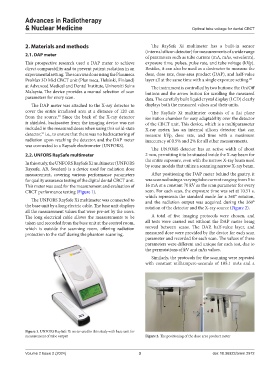
            CBCT performance testing (Figure 1).               scan. For each scan, the exposure time was set at 10.51 s,
                                                               which represents the standard mode for a 360° rotation,
              The UNFORS RaySafe Xi multimeter was connected to   and the radiation output was acquired during the 360°
            the base unit by a long electric cable. The base unit displays   rotation of the detector and the X-ray source (Figure 2).
            all the measurement values that were pre-set by the users.
            The long electrical cable allows the measurements to be   A total of five imaging protocols were chosen, and
            taken and recorded from the base unit at the control room,   all tests were carried out without the DAP meter being
            which is outside the scanning room, offering radiation   moved between scans. The DAP, half-value layer, and
            protection to the staff during the phantom scanning.  measured dose were provided by the device for each scan
                                                               parameter and recorded for each scan. The values of these
                                                               parameters were different and unique for each test, due to
                                                               the permutations of kV and mAs values.
                                                                 Similarly, the protocols for the scanning were repeated
                                                               with constant milliampere-seconds of 105.1 mAs and a


            Figure 1. UNFORS RaySafe Xi meter used in this study with base unit for
            measurement of tube output                         Figure 2. The positioning of the dose area product meter


            Volume 2 Issue 2 (2024)                         3                              doi: 10.36922/arnm.2972

