


Page 65 - ARNM-2-2
P. 65
Advances in Radiotherapy
            & Nuclear Medicine                                                     Optimal tube voltage for dental CBCT


                                                                 The purpose of our study was to evaluate the overall
                                                               effect of varying tube currents at constant tube voltage and
                                                               varying tube voltage at constant tube current on the amount
                                                               of noise produced in each protocol. We wanted to find
                                                               out whether it is possible to vary the tube voltage when
                                                               maintaining the same image quality without a substantial
                                                               change in noise level. 4

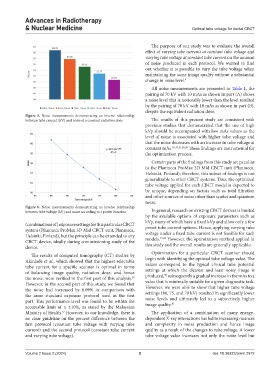
                                                                 All noise measurements are presented in Table 1, the
                                                               pairing of 70 kV with 10 mAs as shown in part (A) shows
                                                               a noise level that is noticeably lower than the level resulted
                                                               by the pairing of 70 kV with 10 mAs as shown in part (B),
                                                               despite the equivalent radiation dose.
            Figure  5. Noise measurements demonstrating an inverse relationship
            between tube current (kV) and noise at a constant radiation dose  The results of this present study are consistent with
                                                               previous studies that demonstrated that the use of high
                                                               kVp should be accompanied with low mAs values as the
                                                               level of noise is associated with higher tube voltage and
                                                               that the noise decreases with an increase in tube voltage at
                                                               constant mAs. 10,17,23,26,28  These findings are instrumental for
                                                               the optimization process.
                                                                 Certain parts of the findings from this study are peculiar
                                                               to the Planmeca ProMax 3D Mid CBCT unit (Planmeca,
                                                               Helsinki, Finland); therefore, this subset of findings is not
                                                               generalizable to other CBCT systems. Thus, the optimized
                                                               tube voltage applied for each CBCT model is expected to
                                                               be unique, depending on factors such as total filtration
                                                               and other sources of noise other than scatter and quantum
                                                               noise.
            Figure  6. Noise measurements demonstrating an inverse relationship
            between tube voltage (kV) and noise according to a power function  In general, research on existing CBCT devices is limited
                                                               by the available options of exposure parameters such as
            (combinations of) exposure settings for this particular CBCT   kVp, many of which have a fixed kVp and allow only a few
            system (Planmeca ProMax 3D Mid CBCT unit, Planmeca,   preset tube current options. Hence, applying varying tube
            Helsinki, Finland), but the principle can be extended to any   voltage under a fixed tube current is not feasible for such
                                                                         However, the optimization method applied in
                                                               models.
                                                                     15,29
            CBCT device, ideally during commissioning study of the   this study and the overall results are generally applicable.
            device.
              The results of computed tomography (CT) studies by   Optimization for a particular CBCT scanner should
            Akinlade et al., which showed that the highest selectable   begin with identifying the optimal tube voltage value. The
            tube current for a specific scanner is optimal in terms   values correspond to the typical clinical tube potential
            of balancing image quality, radiation dose, and hence   settings at which the clearest and least noisy image is
                                                                       30
            the noise, were verified in the first part of this analysis.    produced,  subsequently a gradual increase in the mAs to a
                                                         26
            However, in the second part of this study, we found that   value that is minimally suitable for a given diagnostic task.
            the noise had increased by 0.09% in comparison with   However, we were able to show that higher tube voltage
            the same standard exposure protocol used in the first   settings (80, 75, and 70 kV) resulted in significantly lower
            part. This performance level was found to be within the   noise levels and ultimately led to a subjectively higher
                                                                          30
            acceptable limit of ≤ ±10%, as  stated by the Malaysian   image quality.
            Ministry of Health.  However, to our knowledge, there is   The application of a combination of many energy-
                           27
            no clear guideline on the percent difference between the   dependent X-ray interactions has led to increasing nuances
            first protocol (constant tube voltage with varying tube   and complexity in noise production and hence image
            current) and the second protocol (constant tube current   quality as a result of the changes to tube voltage. A lower
            and varying tube voltage).                         tube voltage value increases not only the noise level but


            Volume 2 Issue 2 (2024)                         5                              doi: 10.36922/arnm.2972

