


Page 101 - ARNM-2-3
P. 101
Advances in Radiotherapy
& Nuclear Medicine Beta radiation doses from Y-90 microsphere
The target material for simulated energy deposition
was the liver tissue described by the ICRU report 44, 1 exp
22
3
with a density of 1.06 g/cm . To generate the sphere, c c
X ()
1
the PENGEOM package was used, which is capable 1
of producing objects to be included in the simulation B c
X (),
from quadric surfaces, which means that from a set of J 2
exp 11 2 2 (I)
second-degree equations, it is possible to reproduce f
objects that are part of the simulation, like the analyzed 1 2
microsphere. 2
In the case of the resin microsphere, in which the
radioactivity is only found in more superficial layers of
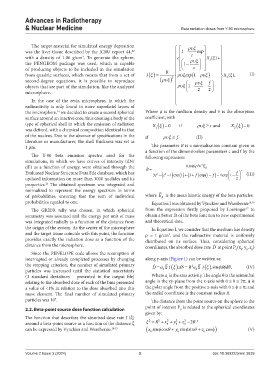
the microsphere, we decided to create a second spherical Where r is the medium density and n is the absorption
14
surface around an inactive core, thus creating a body of the coefficient, with
type of spherical shell in which the emission of radiation X 0 if c and X
0
was defined, with a chemical composition identical to that 1 2
of the nucleus. Due to the absence of specifications in the if f (II)
literature or manufacturer, the shell thickness was set as
1 μm. The parameter B is a normalization constant given as
a function of the dimensionless parameters c and f by the
The Y-90 beta emission spectra used for the following expression:
simulations, in which we have curves of intensity (dN/
.
2
dE) as a function of energy, were obtained through the B 0 046 3 E , ,
Evaluated Nuclear Structure Data File database, which has 3 c c 1 exp 3 f exp 1 f 4exp 1 f (III)
2
2
1
updated information on more than 3000 nuclides and its 2
23
properties. The obtained spectrum was integrated and
normalized to represent the energy spectrum in terms
of probabilities, ensuring that the sum of individual where E is the mean kinetic energy of the beta particles.
β
probabilities equaled to one. Equation I was obtained by Vynckier and Wambersie 18,19
17
The GRIDR tally was chosen, in which spherical from the expression firstly proposed by Loevinger to
symmetry was assumed and the energy per unit of mass obtain a better fit of the beta function to new experimental
was integrated radially as a function of the distance from and theoretical data.
the origin of the system. As the center of the microsphere In Equation I, we consider that the medium has density
and the target tissue coincide with this point, the function r = 1 g/cm , and the radioactive material is uniformly
3
provides exactly the radiation dose as a function of the distributed on its surface. Thus, considering spherical
distance from the microsphere. coordinates, the absorbed dose rate D at point P (x , y , z )
Since the PENELOPE code allows the resumption of 0 0 0 0
interrupted or already completed processes by changing along y-axis (Figure 1) can be written as:
the stopping criterion, the number of simulated primary Da J . dSR a 2 J .sin (IV)
dd,
particles was increased until the statistical uncertainty S S
(3 standard deviations – presented in the output file) Where a is the area activity. The angle q is the azimuthal
s
relating to the absorbed dose of each of the bins presented angle in the xy-plane from the x-axis with 0 ≤ q ≤ 2p; f is
a value of <1% in relation to the dose absorbed into this the polar angle from the positive z-axis with 0 ≤ f ≤ p; and
mass element. The final number of simulated primary the radial coordinate is the constant radius R.
9
particles was 10 . The distance from the point source on the sphere to the
2.2. Beta-point source dose function calculation point of interest P is related to the spherical coordinates
0
given by:
The function that describes the absorbed dose rate J (ξ)
2
around a beta-point source as a function of the distance ξ R 2 x 2 0 y 2 0 z 2 0 2R *
can be expressed by Vynckier and Wambersie. 18,19 0 x sincos y sinsin z cos (V)
0
0
Volume 2 Issue 3 (2024) 3 doi: 10.36922/arnm.3639

