


Page 100 - ARNM-2-3
P. 100
Advances in Radiotherapy
            & Nuclear Medicine                                                Beta radiation doses from Y-90 microsphere


              In this study, estimations of the beta dose rates alongside   for understanding the dose distribution around individual
            the radial distance of a microsphere containing the   microspheres, which is a building block for modeling more
            Yttrium-90 radionuclide were performed. Yttrium-90 has   complex systems involving multiple microspheres.
            a physical half-life of 2.7 days and emits beta particles with
            a maximum energy of 2.28 MeV (mean energy of 0.933   2. Materials and methods
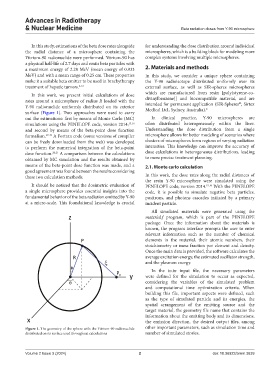
            MeV) and with a mean range of 0.25 cm. These properties   In this study, we consider a unique sphere containing
            make it a suitable beta emitter to be used in brachytherapy   the Y-90 radioisotope distributed uniformly over its
            treatment of hepatic tumors. 2-12                  external surface, as well as SIR-spheres microspheres
              In this work, we present initial calculations of dose   which are manufactured from resin [poly(styrene-co-
            rates around a microsphere of radius R loaded with the   divinylbenzene)]  and  biocompatible  material,  and  are
                                                               intended for permanent application (SIR-Spheres , Sirtex
                                                                                                       ®
            Y-90 radionuclide uniformly distributed on its exterior                      2
            surface (Figure  1). Two approaches were used to carry   Medical Ltd., Sydney, Australia).
            out the estimations: first by means of Monte Carlo (MC)   In  clinical  practice,  Y-90  microspheres  are
            simulations using the PENELOPE code, version 2014; 15,16    often distributed heterogeneously within the liver.
            and second by means of the beta-point dose function   Understanding the dose distribution from a single
            formalism. 17-19  A Fortran code (some versions of compiler   microsphere allows for better modeling of scenarios where
            can be freely downloaded from the web) was developed   clusters of microspheres form regions of varying radiation
            to perform the numerical integration of the beta-point   intensities. This knowledge can improve the accuracy of
            dose function. 20,21  A comparison between the calculations   dose calculations in heterogeneous distributions, leading
            obtained  by  MC simulation  and  the  results  obtained  by   to more precise treatment planning.
            means of the beta-point dose function was made, and a   2.1. Monte carlo calculation
            good agreement was found between the results considering
            these two calculation methods.                     In this work, the dose rates along the radial distances of
                                                               the resin Y-90 microsphere were simulated using the
              It should be noticed that the dosimetric evaluation of   PENELOPE code, version 2014. 15,16  With the PENELOPE
            a single microsphere provides essential insights into the   code,  it is  possible  to simulate  negative  beta particles,
            fundamental behavior of the beta radiation emitted by Y-90   positrons, and photons cascades initiated by a primary
            at  a  micro-scale.  This  foundational  knowledge  is  crucial   incident particle.
                                                                 All simulated materials were generated using the
                                                               material.f program, which is part of the PENELOPE
                                                               package.  Once  the  information  about  the  materials  is
                                                               known, the program interface prompts the user to enter
                                                               relevant information such as the number of chemical
                                                               elements in the material, their atomic numbers, their
                                                               stoichiometry or mass fraction per element and density.
                                                               Once the main data is provided, the software calculates the
                                                               average excitation energy, the estimated oscillator strength,
                                                               and the plasmon energy.
                                                                 In  the  in.in  input  file,  the  necessary  parameters
                                                               were defined for the simulation to occur as expected,
                                                               considering the variables of the simulated problem
                                                               and computational time optimization criteria. When
                                                               building  this  file,  important  aspects  were  defined,  such
                                                               as the type of simulated particle and its energies, the
                                                               spatial arrangement of the emitting source and the
                                                               target material, the geometry file name that contains the
                                                               information about the emitting body and its dimensions,
                                                               the emission direction, the desired output files, among
            Figure 1. The geometry of the sphere with the Yttrium-90 radionuclide   other important parameters, such as simulation time and
            distributed on its surface used throughout calculations  number of simulated stories.


            Volume 2 Issue 3 (2024)                         2                              doi: 10.36922/arnm.3639

