


Page 95 - ARNM-2-3
P. 95
Advances in Radiotherapy
            & Nuclear Medicine                                                  Radiotherapy with neutron/gamma tubes


            moderating the 2.5 MeV d-d neutrons or the 10 and   arrive at the tumor site. The distribution of epithermal and
            13 MeV d- Li neutrons. Alternatively, they can be directly   thermal neutron flux inside the body has been studied in
                     7
            produced by employing the  Li(p,n) Be reaction near   detailed by Nakagawa in one chapter of the book.  Using a
                                           7
                                                                                                      14
                                     7
            the threshold interaction energy (1.881 MeV). 12,13  This   1.9 MV and 10 mA H  ion beam with a diameter of 2 cm,
                                                                                −
            approach to forming epithermal neutrons offers several   the total neutron yield is 1.5 × 10  n/s with mean neutron
                                                                                         11
            advantages. First, as no moderation is needed, the   energy of 38 keV and a mean neutron angle of 23 .  For
                                                                                                        0 12
            epithermal neutron flux is higher. Second, the epithermal   a H  ion beam with a diameter of 5 cm and an ion beam
                                                                  −
            neutrons formed at near-threshold energy are directional   current of 70 mA, the average neutron yield for a 1% DF
            with a mean neutron angle of approximately 20 . Therefore,   operation is approximately 1 × 10   n/s, or an average
                                                                                            10
                                                 0
            shielding is not needed on the side and at the back of the   epithermal neutron flux of 5 × 10  n/cm /s, which is the
                                                                                           8
                                                                                                2
            neutron generator. Third, the d-d and the d- Li neutrons   recommended value for BNCT treatment. 15
                                                7
            are emitted isotropically, therefore more than 50% of these   A single p- Li neutron tube with a 5-cm diameter beam
                                                                          7
            neutrons produced are wasted but not the near-threshold   target can provide the required epithermal neutron flux
            produced p- Li neutrons. In the past, this approach of   for BNCT. Alternatively, one can employ a cluster of mini
                      7
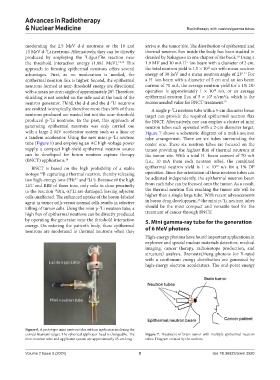
            generating epithermal  neutrons was  only carried  out   neutron tubes each operated with a 2-cm diameter target.
            with a large 2 MV accelerator system such as a linac or   Figure  7 shows a  schematic  diagram of a multi-neutron
            a tandem accelerator. Using the new mini p- Li neutron   tube arrangement. There are six tubes surrounding the
                                                 7
            tube (Figure 1) and employing an AC high-voltage power   center one. These six neutron tubes are focused on the
            supply, a compact high-yield epithermal neutron source   tumor providing the highest flux of thermal neutrons at
            can be developed for boron neutron capture  therapy   the tumor site. With a total H  beam current of 70 mA
                                                                                        −
            (BNCT) applications. 14                            (i.e.,  10  mA from each neutron tube), the combined
                                                                                             10
              BNCT is based on the high probability of a stable   epithermal neutron yield is 1 × 10   n/s for a 1% DF
            isotope  B capturing a thermal neutron, thereby releasing   operation. Since the orientation of these neutron tubes can
                  10
            two high-energy ions ( He  and  Li ). Because of the high   be adjusted independently, the epithermal neutron beam
                                      7
                                        +
                                 2+
                              4
            LET and RBE of these ions, only cells in close proximity   from each tube can be focused onto the tumor. As a result,
            to the reaction  B(n, α) Li are damaged, leaving adjacent   the thermal neutron flux reaching the tumor site will be
                        10
                               7
            cells unaffected. The enhanced uptake of the boron-labeled   higher than a single large tube. With recent advancements
                                                                                     16
                                                                                                7
            agent in tumor cells versus normal cells results in selective   in boron drug development,  the mini p- Li neutron tubes
            killing of tumor cells. Using the mini p- Li neutron tube, a   should be  the most compact and versatile tool for  the
                                           7
            high flux of epithermal neutrons can be directly produced   treatment of cancer through BNCT.
            by operating the generator near the threshold interaction   5. Mini gamma-ray tube for the generation
            energy. On entering the patient’s body, these epithermal   of 6 MeV photons
            neutrons are moderated to thermal neutrons when they
                                                               High-energy photons have found important applications in
                                                               explosive and special nuclear materials detection, medical
                                                               imaging, cancer therapy, radioisotope production, and
                                                               structural analysis. Bremsstrahlung photons (or X-rays)
                                                               with a continuum energy distribution are generated by
                                                               high-energy electron accelerators. The end-point energy


            Figure 6. A prototype mini neutron tube with an applicator enclosing the
            conical titanium target. The spherical applicator head is changeable. The   Figure 7. Treatment of brain tumor with multiple epithermal neutron
            mini neutron tube and applicator system are approximately 25-cm long.  tubes. Diagram created by the authors.


            Volume 2 Issue 3 (2024)                         5                              doi: 10.36922/arnm.3920

