


Page 93 - ARNM-2-3
P. 93
Advances in Radiotherapy
            & Nuclear Medicine                                                  Radiotherapy with neutron/gamma tubes


            yield becomes 2 × 10  n/s and the average neutron yield is
                            11
            2 × 10  n/s for 1% DF operation.
                 9
              The beam target for the d-d neutron tube is a round
            copper disk. It is coated with a thin layer of titanium on the
            one side. Deuterium atoms are absorbed on the titanium
            surface. Under ion beam bombardment, the temperature of
            the target electrode will increase. If the temperature exceeds
            250°C, most of the deuterium atoms will evaporate away.
            The probability for the d-d fusion reaction to occur becomes
            smaller. To maintain a high neutron yield, the target electrode
            must be cooled by compressed air. For a 1 MV, 10  mA
            D  ion beam, the power density on the target electrode
             −
                                              2
            with a diameter of 2 cm is about 3 kW/cm  for continuous
            operation. For 1% DF pulsed operation, the power density
                         2
            is only 30 W/cm . Air cooling can easily maintain the target
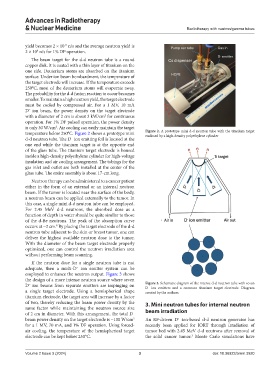
            temperature below 250°C. Figure 2 shows a prototype mini   Figure 2. A prototype mini d-d neutron tube with the titanium target
                                                               enclosed by a high-density polyethylene cylinder
            d-d neutron tube. The D  ion emitting foil is located at the
                               −
            one end while the titanium target is at the opposite end
            of the glass tube. The titanium target electrode is housed
            inside a high-density polyethylene cylinder for high-voltage
            insulation and air cooling arrangement. The tubings for the
            gas inlet and outlet are both installed at the center of the
            glass tube. The entire assembly is about 17-cm long.
              Neutron therapy can be administered to a cancer patient
            either in the form of an external or an internal neutron
            beam. If the tumor is located near the surface of the body,
            a neutron beam can be applied externally to the tumor. In
            this case, a single mini d-d neutron tube can be employed.
            For 2.45 MeV d-d neutrons, the absorbed dose as a
            function of depth in water should be quite similar to those
            of the d-Be neutrons. The peak of the absorption curve
            occurs at ~2 cm.  By placing the target electrode of the d-d
                         8
            neutron tube adjacent to the skin or breast tumor, one can
            deliver  the  highest  available  neutron  dose  to  the tumor.
            With the diameter of the beam target electrode properly
            optimized, one can control the neutron irradiation area
            without performing beam scanning.
              If the neutron dose for a single neutron tube is not
            adequate, then a multi-D  ion emitter system can be
                                  −
            employed to enhance the neutron output. Figure 3 shows
            the design of a more intense neutron source where seven
            D  ion beams from separate emitters are impinging on   Figure 3. Schematic diagram of the intense d-d neutron tube with seven
             −
                                                               D  ion emitters and a common titanium target electrode. Diagram
                                                                −
            a  single  target  electrode.  Using  a  hemispherical  shape   created by the authors.
            titanium electrode, the target area will increase by a factor
            of two, thereby reducing the beam power density by the   3. Mini neutron tubes for internal neutron
            same  factor  while  maintaining  the  neutron  source  size   beam irradiation
            of 2 cm in diameter. With this arrangement, the total D
                                                          −
            beam power density on the target electrode is ~100 W/cm    An RF-driven D  ion-based d-d neutron generator has
                                                          2
                                                                             +
            for a 1 MV, 70 mA, and 1% DF operation. Using forced-  recently been applied for IORT through irradiation of
            air cooling, the temperature of the hemispherical target   tumor bed with 2.45 MeV d-d neutrons after removal of
            electrode can be kept below 250°C.                 the solid cancer tumor.  Monte Carlo simulations have
                                                                                   3
            Volume 2 Issue 3 (2024)                         3                              doi: 10.36922/arnm.3920

