


Page 88 - ARNM-2-3
P. 88
Advances in Radiotherapy
            & Nuclear Medicine                                                    OrthoCT experimental proof of concept


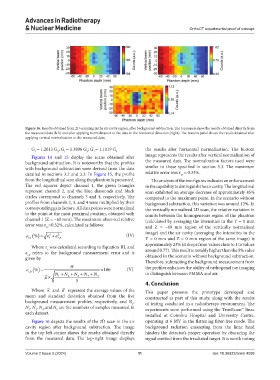
            Figure 16. Results obtained from 2D scanning in the air cavity region, after background subtraction. The top panels show the results obtained directly from
            the measured data (left) and after applying normalization to the data in the horizontal direction (right). The bottom panel shows the result obtained after
            applying vertical normalization to the measured data.

              G = 1.2013 G ; G = 1.3896 G ; G = 1.1019 G       the results after horizontal normalization. The bottom
                1        2  1         3  1        4
              Figures  14  and  15  display  the scans obtained after   image represents the results after vertical normalization of
            background subtraction. It is noteworthy that the profiles   the measured data. The normalization factors used were
            with background subtraction were derived from the data   similar to those specified in section 3.3. The maximum
            detailed in sections 3.2 and 3.3. In Figure 15, the profile   relative error was  = 0.33%.
                                                                              r,t
            from the longitudinal scan along the phantom is presented.   The analysis of the two figures indicates an enhancement
            The red squares depict channel 1, the green triangles   in the capability to distinguish the air cavity. The longitudinal
            represent channel 2, and the blue diamonds and black   scan exhibited an average decrease of approximately 45%
            circles correspond to channels 3 and 4, respectively. The   compared to the maximum point. In the scenario without
            profiles from channels 2, 3, and 4 were multiplied by their   background subtraction, this variation was around 12%. In
            corresponding gain factors. All data points were normalized   the vertically normalized 2D scan, the relative variation in
            to the point at the most proximal position, obtained with   counts between the homogeneous region of the phantom
            channel 1 (Z = −60 mm). The maximum observed relative   (calculated by averaging the intensities in the Y = 0 mm
            error was  =0.32%, calculated as follows:
                     r,t                                       and Z = −60  mm region of the vertically normalized
            ε  rt ,  ( ) =%  ε  r 2  ε +  2 , rb       (IV)    image) and the air cavity (averaging the intensities in the
                                                               Y = 0 mm and Z = 0 mm region of the same image) is
              Where   was calculated according to Equation III, and   approximately 23% (it drops from values close to 1 to values
                     r
              refers to the background measurement error and is   around 0.77). This result is notably higher than the 5% value
             r,b
            given by                                           obtained in the scenario without background subtraction.
                                                               Therefore, subtracting the background measurement from
                               σ                               the profiles enhances the ability of orthogonal ray imaging
               ( ) =
            ε  %                            ×100       (V)     to distinguish between PMMA and air.
              , rb
                    µ ×   1 + N  2  + N  3  + N  4  + N  N 5
                                 5
                                                               4. Conclusion
              Where  ∝  and  σ  represent the average values of the   This  paper  presents the  prototype  developed and
            mean and standard deviation obtained from the five   constructed as part of this study,  along with the results
            background measurement profiles, respectively, and  N ,   of testing conducted in a radiotherapy environment. The
                                                         1
            N , N , N ,andN  are the numbers of samples measured in   experiments were performed using the TrueBeam™ linac

                         5
             2
                   4
                3
            each dataset.
                                                               installed at  Coimbra  Hospital  and University Centre,
              Figure 16 depicts the results of the 2D scan in the air   operating at 6 MV in the flattening filter-free mode. The
            cavity region after background subtraction. The image   background radiation emanating from the linac head
            in the top left corner shows the results obtained directly   hinders the detector’s proper operation by obscuring the
            from the measured data. The top-right image displays   signal emitted from the irradiated target. It is worth noting
            Volume 2 Issue 3 (2024)                         11                             doi: 10.36922/arnm.4099

