


Page 86 - ARNM-2-3
P. 86
Advances in Radiotherapy
            & Nuclear Medicine                                                    OrthoCT experimental proof of concept


            Table 1. Determination of the relative gain of each channel: Value obtained for each irradiation position and the corresponding
            average
            Position 1        Irradiation #      Channel 1         Channel 2        Channel 3         Channel 4
                              1                   1030.94           865.85            760.38           860.28
                              2                   1037.98           867.30            760.27           867.34
                              3                   1035.00           866.08            762.08           862.40
                              4                   1034.38           871.09            756.20           861.28
                              5                   1035.38           866.77            759.73           861.21
                              Average             1034.74           867.42            759.73           862.50
            Position 2        1                   1043.04           875.81            763.28           868.45
                              2                   1043.13           875.51            762.99           870.87
                              3                   1035.89           879.55            763.80           873.44
                              4                   1035.89           875.89            762.01           875.11
                              5                   1040.27           881.16            771.06           873.38
                              Average             1039.64           877.59            764.63           877.25


              This means that using channel 1 as the reference, the
            values obtained for channels 2, 3, and 4 must be multiplied
            by 1.1791, 1.3376, and 1.1650, respectively, to calibrate the
            relative gains. It should be noted that as the position of
            the phantom varies, the geometry of the system changes,
            including the distance from the source to the surface of the
            phantom. In addition, the cross-sectional area of the beam
            changes due to its divergence. This could potentially change
            the relative gain between the two channels. However, the
            induced variations were considered to be minimal and
            therefore were not taken into account in the approach used
            to calculate the relative gains.

            3.2. Longitudinal scan along the phantom
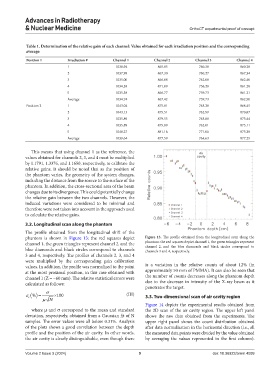
            The profile obtained from the longitudinal shift of the
            phantom is shown in  Figure  13: the red squares depict   Figure  13. The profile obtained from the longitudinal scan along the
            channel 1, the green triangles represent channel 2, and the   phantom: the red squares depict channel 1, the green triangles represent
                                                               channel 2, and the blue diamonds and black circles correspond to
            blue diamonds and black circles correspond to channels   channels 3 and 4, respectively.
            3 and 4, respectively. The profiles of channels 2, 3, and 4
            were multiplied by the corresponding gain calibration
            values. In addition, the profile was normalized to the point   is a variation in the relative counts of about 12% (in
            at the most proximal position, in this case obtained with   approximately 50 mm of PMMA). It can also be seen that
            channel 1 (Z = −60 mm). The relative statistical errors were   the number of counts decreases along the phantom depth
            calculated as follows:                             due to the decrease in intensity of the X-ray beam as it
                                                               penetrates the target.
                     σ
            ε ( ) =%    ×  100                         (III)   3.3. Two-dimensional scan of air cavity region
             r
                   µ  N
                                                               Figure  14 depicts the experimental results obtained from
              where µ and σ correspond to the mean and standard   the 2D scan of the air cavity region. The upper left panel
            deviation, respectively, obtained from a Gaussian fit of N   shows the raw data obtained from the experiments. The
            samples. The error values were all below 0.31%. Analysis   upper right panel shows the count distribution obtained
            of the plots shows a good correlation between the depth   after data normalization in the horizontal direction (i.e., all
            profile and the position of the air cavity. In other words,   the measured data points were divided by the value obtained
            the air cavity is clearly distinguishable, even though there   by averaging the values represented in the first column).


            Volume 2 Issue 3 (2024)                         9                              doi: 10.36922/arnm.4099

