


Page 85 - ARNM-2-3
P. 85
Advances in Radiotherapy
            & Nuclear Medicine                                                    OrthoCT experimental proof of concept


            the phantom and the collimator surface was 80 mm. The   2.5.2. Longitudinal scan along the phantom
            phantom was irradiated with a 5  mm × 5  mm beam at   To obtain a longitudinal scan, the phantom was moved
            the isocenter (as described in section 2.3) with the linac   from Z  = −60  mm to Z = +60  mm  in steps of 10  mm
            head positioned at 270° (i.e., the beam entered from the   (distances as defined in the experimental setup depicted
            left side of the phantom). Each acquisition lasted 45 s to   in Figure 11).
            acquire at least 1000 events for each phantom position.
            This long-time irradiation was due to the dead time of   2.5.3. 2D scan of air cavity region
            the acquisition system. However, the aim of this work was   A 2D image of the air cavity region was obtained. For this
            to demonstrate the concept of the OrthoCT technique.   purpose, longitudinal scans were performed at different
            Therefore, optimizing the acquisition system, including   heights, effectively creating a 2D scan in the region of the
            considerations of dead time, was not considered within the   air cavity. The longitudinal scans covered an area between
            scope of this study.                               Z = −62 mm and Z = +70 mm with steps of ΔZ = 22.8 mm.

            2.5.1. Relative gain of each prototype channel     In the vertical direction, the step size was  ΔY = 5  mm,
                                                               encompassing the region from Y = −30 mm to Y = +30 mm.
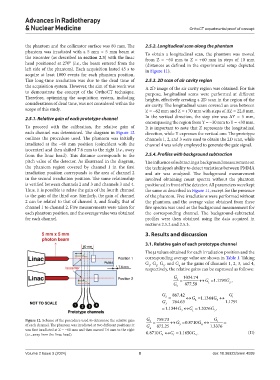
            To  proceed  with  the  calibration,  the relative  gain of   It is important to note that Z represents the longitudinal
            each channel was determined. The diagram in Figure 12   direction, while Y expresses the vertical one. The prototype
            outlines the procedure used. The phantom was initially   channels 1, 2, and 3 were used to obtain the 2D scan, while
            irradiated at the −60  mm position (coincident with the   channel 4 was solely employed to generate the gate signal.
            isocenter) and then shifted 7.6 mm to the right (i.e., away
            from the linac head). This distance corresponds to the   2.5.4. Profiles with background subtraction
            pitch value of the detector. As illustrated in the diagram,   The influence of subtracting a background measurement on
            the phantom region covered by channel 1 in the first   the technique’s ability to detect variations between PMMA
            irradiation position corresponds to the area of channel 2   and air was analyzed. The background measurement
            in the second irradiation position. The same relationship   involved obtaining count spectra without the phantom
            is verified between channels 2 and 3 and channels 3 and 4.   positioned in front of the detector. All parameters were kept
            Thus, it is possible to relate the gain of the fourth channel   the same as described in Figure 11, except for the presence
            to the gain of the third one. Similarly, the gain of channel   of the phantom. Five irradiations were performed without
            2 can be related to that of channel 3, and finally, that of   the phantom, and the average value obtained from these
            channel 1 to channel 2. Five measurements were taken for   five spectra was used as the background measurement for
            each phantom position, and the average value was obtained   the corresponding channel. The background-subtracted
            for each channel.                                  profiles were then obtained using the data acquired in
                                                               sections 2.5.2 and 2.5.3.
                                                               3. Results and discussion

                                                               3.1. Relative gain of each prototype channel
                                                               The µ values obtained for each irradiation position and the
                                                               corresponding average value are shown in Table 1. Taking
                                                               G , G , G , and G  as the gains of channels 1, 2, 3, and 4,
                                                                1
                                                                             4
                                                                      3
                                                                   2
                                                               respectively, the relative gains can be expressed as follows:
                                                                           G 1  =  1034.74  ↔  = G  1 .1791  ,
                                                                                                 G
                                                                           G 2  877.59    1        2
                                                                      G 2  =  867.42  ↔  = G  1 .1344   ↔ G  G 1
                                                                      G 3  764.63   2        3   1.1791
                                                                      =  1.1344  3  ↔G  1  =G  1.3376G 3  ,

            Figure 12. Scheme of the procedure used to determine the relative gain   G 3  =  759.73  ↔  = G   0.8710   ↔G  G 1  =
            of each channel. The phantom was irradiated at two different positions: it   G  872.25  3  4  1.3376
            was first irradiated at Z = −60 mm and then moved 7.6 mm to the right   4
            (i.e., away from the linac head).                  0.8710  4  ↔G  1  =G  1.1650G 4  .          (II)


            Volume 2 Issue 3 (2024)                         8                              doi: 10.36922/arnm.4099

