


Page 80 - ARNM-2-3
P. 80
Advances in Radiotherapy
            & Nuclear Medicine                                                    OrthoCT experimental proof of concept


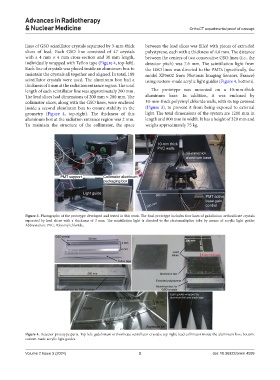
            lines of GSO scintillator crystals separated by 3-mm-thick   between the lead slices was filled with pieces of extruded
            slices  of lead. Each  GSO line consisted of 47 crystals   polystyrene, each with a thickness of 4.6 mm. The distance
            with a 4 mm × 4 mm cross-section and 30 mm length,   between the centers of two consecutive GSO lines (i.e., the
            individually wrapped with Teflon tape (Figure 4, top-left).   detector pitch) was 7.6 mm. The scintillation light from
            Each line of crystals was placed inside an aluminum box to   the GSO lines was directed to the PMTs (specifically, the
            maintain the crystals all together and aligned. In total, 188   model XP5602 from Photonis Imaging Sensors, France)
            scintillator crystals were used. The aluminum box had a   using custom-made acrylic light guides (Figure 4, bottom).
            thickness of 1 mm at the radiation entrance region. The total
            length of each scintillator line was approximately 200 mm.   The prototype was mounted on a 10-mm-thick
            The lead slices had dimensions of 200 mm × 200 mm. The   aluminum base. In addition, it was enclosed by
            collimator slices, along with the GSO lines, were enclosed   10-mm-thick polyvinyl chloride walls, with its top covered
            inside a second aluminum box to ensure stability in the   (Figure 3), to prevent it from being exposed to external
            geometry (Figure  4, top-right). The thickness of this   light. The total dimensions of the system are 1200 mm in
            aluminum box at the radiation entrance region was 2 mm.   length and 800 mm in width. It has a height of 320 mm and
            To maintain the structure of the collimator, the space   weighs approximately 75 kg.


            Figure 3. Photographs of the prototype developed and tested in this work. The final prototype includes four lines of gadolinium orthosilicate crystals
            separated by lead slices with a thickness of 3  mm. The scintillation light is directed to the photomultiplier tube by means of acrylic light guides
            Abbreviation: PVC: Polyvinyl chloride.


            Figure 4. Detector prototype parts. Top-left: gadolinium orthosilicate scintillator crystals; top-right: lead collimator inside the aluminum box; bottom:
            custom-made acrylic light guides.


            Volume 2 Issue 3 (2024)                         3                              doi: 10.36922/arnm.4099

