


Page 79 - ARNM-2-3
P. 79
Advances in Radiotherapy
            & Nuclear Medicine                                                    OrthoCT experimental proof of concept


            include (1) formation of edema in the irradiated area,
            (2) tumor regression/progression, (3) filling of cavities
            with edematous tissue (e.g., due to inflammation),
            (4) change in tissue permeability, (5) weight loss/gain, and
            (6) misalignment of patient positioning, among others. 2-6

              Image-guided radiation therapy (IGRT) allows for
            more precise tumor targeting, thereby reducing the side
            effects  of  eventual  morphological  and/or  anatomical
            changes. Cone-beam computed tomography is one of
            the most commonly used IGRT techniques for treatment
            monitoring, as it provides visualization of the target with
            volumetric imaging and relatively high-resolution soft-
                           7
            tissue information.  However, this technique results in
                                                                                                   10
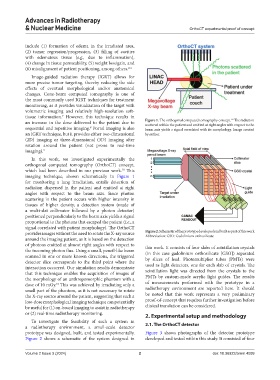
            an  increase  in  the  dose delivered  to  the patient  due  to   Figure 1. The orthogonal computed tomography concept.  The radiation
                                                               scattered within the patient and emitted at right angles with respect to the
            sequential and repetitive imaging.  Portal imaging is also   beam axis yields a signal correlated with its morphology. Image created
                                       8
            an IGRT technique, but it provides either two-dimensional   by author.
            (2D) imaging or three-dimensional (3D) imaging after
            rotation around the patient (not prone to real-time
            imaging). 9
              In this work, we investigated experimentally the
            orthogonal computed tomography (OrthoCT) concept,
            which  had  been  described  in  our  previous  work.   This
                                                     10
            imaging technique, shown  schematically in  Figure  1
            for  monitoring  a  lung  irradiation,  entails  detection  of
            radiation dispersed in the patient and emitted at right
            angles with respect to the beam axis. Since photon
            scattering in the patient occurs with higher intensity in
            tissues of higher density, a detection system (made of
            a multi-slat collimator followed by a photon detector)
            positioned perpendicularly to the beam axis yields a signal
            proportional to the photons that escaped the patient (i.e., a
            signal correlated with patient morphology). The OrthoCT
            provides images without the need to rotate the X-ray source   Figure 2. Schematic of the prototype developed and built as part of this work
                                                               Abbreviation: GSO: Gadolinium orthosilicate.
            around the imaging patient, as it is based on the detection
            of photons emitted at almost right angles with respect to   this work. It consists of four slabs of scintillation crystals
            the incoming photon flux. Using a small, pencil-like beam   (in this case gadolinium orthosilicate [GSO]) separated
            scanned in one or more known directions, the triggered   by  slices  of  lead.  Photomultiplier  tubes  (PMTs)  were
            detector slice corresponds to the third point where the   used as light detectors, one for each slab of crystals. The
            interaction occurred. Our simulation results demonstrate
            that this technique enables the acquisition of images of   scintillation light was directed from the crystals to the
            the morphology of an anthropomorphic phantom with a   PMTs by custom-made acrylic light guides. The results
            dose of 10 mGy.  This was achieved by irradiating only a   of measurements performed with the prototype in a
                         10
            small part of the phantom, as it is not necessary to rotate   radiotherapy environment  are  reported here. It  should
            the X-ray source around the patient, suggesting that such a   be noted that this work represents a very preliminary
            low-dose morphological imaging technique can potentially   proof-of-concept that requires further investigation before
            be useful for (1) on-board imaging to assist in radiotherapy   clinical translation can be considered.
            or (2) real-time radiotherapy monitoring.          2. Experimental setup and methodology
              To  investigate  the  feasibility of  such  a  system  in
            a radiotherapy environment, a small-scale detector   2.1. The OrthoCT detector
            prototype was designed, built, and tested experimentally.   Figure  3  shows  photographs  of  the  detector  prototype
            Figure  2 shows a  schematic of the system designed in   developed and tested within this study. It consisted of four


            Volume 2 Issue 3 (2024)                         2                              doi: 10.36922/arnm.4099

