


Page 92 - ARNM-2-3
P. 92
Advances in Radiotherapy
            & Nuclear Medicine                                                  Radiotherapy with neutron/gamma tubes


            these  new  findings,  mini neutron/gamma-ray  tubes  are   2.45 MeV neutrons will be produced by the d-d fusion
            now being developed which can eliminate most issues   reaction. Titanium is used as the target material because
            from the larger positive H /D ion-based neutron/gamma-  it is capable of absorbing a large number of deuterium
                                +
                                   +
            ray generators. Using a high-frequency AC high-voltage   atoms on the surface, thereby enabling more d-d reactions
            supply, short pulses of high-intensity neutron or gamma-  to occur and enhancing the neutron yield. Without an
            ray beams can be generated using the d-d, d- B, d- Li,   ion source chamber, the size of the neutron generator is
                                                        7
                                                  10
            p- Li, or p- F nuclear reactions.  This article describes   significantly reduced. In addition, complex power sources
              7
                                       6
                      19
            the design and development of these mini tubes and their   such as an RF or microwave generator and its matching
            applications for neutron or gamma-ray cancer therapy.  network are eliminated,  and a simple heater power supply
                                                                                  7
                                                               is all that is required to produce the H /D ion.
                                                                                                −
                                                                                             −
            2. Mini neutron tube for external neutron
                                                                 For low ion beam current, the neutron tube can be
            beam therapy                                       operated with a DC high voltage (~100 kV) power supply.
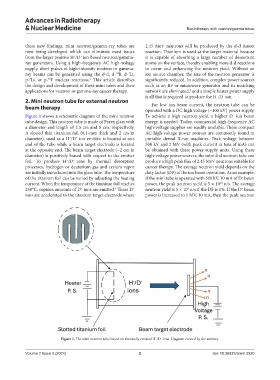
            Figure 1 shows a schematic diagram of the mini neutron   To achieve a high neutron yield, a higher D  ion beam
                                                                                                    −
            tube design. This neutron tube is made of Pyrex glass with   energy is needed. Today, commercial high-frequency AC
            a diameter and length of 2.5 cm and 8 cm, respectively.   high-voltage supplies are readily available. These compact
            A  slotted thin titanium foil (0.1-mm thick and 2  cm in   AC high-voltage power sources  are commonly found in
            diameter), used as a H /D  ion emitter, is located at one   portable dental X-ray machines. Peak voltage between
                               −
                                 −
            end of the tube while a beam target electrode is located   500 kV and 2 MV (with peak current in tens of mA) can
            at the opposite end. The beam target electrode (~2 cm in   be obtained with these power supply units. Using these
            diameter) is positively biased with respect to the emitter   high-voltage power sources, the mini d-d neutron tube can
            foil. To produce H /D ions by thermal desorption   produce a high peak flux of 2.45 MeV neutrons suitable for
                                −
                             −
            processes, hydrogen or deuterium gas and cesium vapor   cancer therapy. The average neutron yield depends on the
            are initially introduced into the glass tube. The temperature   duty factor (DF) of the ion beam operation. As an example,
            of the titanium foil can be varied by adjusting the heating   if the mini tube is operated with 500 kV, 10 mA of D  beam
                                                                                                        −
            current. When the temperature of the titanium foil reaches   power, the peak neutron yield is 5 × 10  n/s. The average
                                                                                               10
            250°C, copious amounts of D  ions are emitted.  These D    neutron yield is 5 × 10  n/s if the DF is 1%. If the D  beam
                                                                                 8
                                                  5
                                                          −
                                                                                                        −
                                   −
            ions are accelerated to the titanium target electrode where   power is increased to 1 MV, 10 mA, then the peak neutron


                           Figure 1. The mini neutron tube based on thermally emitted H /D  ions. Diagram created by the authors.
                                                                     −
                                                                   −
            Volume 2 Issue 3 (2024)                         2                              doi: 10.36922/arnm.3920

