


Page 94 - ARNM-2-3
P. 94
Advances in Radiotherapy
            & Nuclear Medicine                                                  Radiotherapy with neutron/gamma tubes


            demonstrated that operating the d-d neutron generator
            in continuous wave (CW), with a beam power of 100 kV
            and 10 mA, can generate a neutron yield of 3.3 × 10  n/s
                                                       9
            with a neutron flux ~ 8 × 10  n/cm /s at the center of the
                                   7
                                        2
            irradiation window. The delivered dose rate is about 2 Gray
            (RBE)/min, resulting in 4 – 9 min of treatment time.  The
                                                      3
            new mini d-d neutron tube can provide high peak neutron
            doses in pulsed mode operation. By operating the mini
            neutron tube at 500 kV and 10 mA of D  ion beam current,
                                           −
            the peak neutron yield is 5 × 10  n/s. The average neutron
                                     10
            yield becomes 5 × 10  n/s for a 10% DF (1 ms, 100 Hz)
                             9
            operation. Thus, the treatment time should be about the
            same as the larger D  ion-based d-d neutron generator. By
                            +
            positioning the beam target near the center of the tumor
            bed, one can further increase the neutron flux on the cavity
            wall. The near isotropic neutron emission will permit the   Figure 4. Relative angular distribution for the d-d neutrons at 500 keV
                                                               deuteron energy. Modified based on data from Csikai.
                                                                                                 9
            irradiation or “sterilization” of the surrounding side walls
            of the cavity, therefore reducing the chance of cancer
            recurrences.
              The  surgical removal  of  a  tumor  is  usually  followed
            by an IORT procedure. Radiation in the form of photons,
            electrons, protons, or neutrons can be applied. It is essential
            to allow these radiation particles to reach all corners of
            the surrounding walls. In addition, the irradiation should
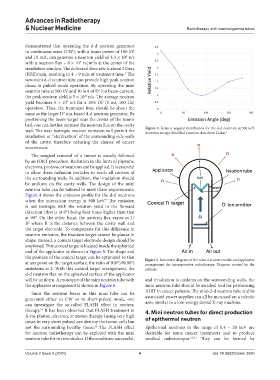
            be uniform on the cavity walls. The design of the mini
            neutron tube can be tailored to meet these requirements.
            Figure 4 shows the emission profile for the d-d neutrons
            when the interaction energy is 500 keV.  The emission
                                              9
            is not isotropic with the neutron yield in the forward
            direction (that is at 0°) being four times higher than that
            at 90°. On the other hand, the neutron flux varies as 1/
            R  where R is the distance between the cavity wall and
             2
            the target electrode. To compensate for this difference in
            neutron emission, the titanium target cannot be planar in
            shape. Instead, a conical target electrode design should be
            employed. This conical target is located inside the spherical
            end of the applicator as shown in Figure 5. The shape and
            the position of the conical target can be optimized so that   Figure 5. Schematic diagram of the mini d-d neutron tube and applicator
            at any point on the target surface, the ratio of R(0°)/R(90°)   arrangement for intraoperative radiotherapy. Diagram created by the
            maintains at 2. With this conical target arrangement, the   authors.
            d-d neutron flux on the spherical surface of the applicator
            will be uniform. A prototype of the mini neutron tube with   and irradiation is uniform on the surrounding walls, the
            the applicator arrangement is shown in Figure 6.   mini neutron tube should be an ideal tool for performing
              Since the neutron beam in this mini tube can be   IORT in cancer patients. The mini d-d neutron tube and its
            generated either in CW or in short-pulsed mode, one   associated power supplies can all be mounted on a robotic
            can investigate the so-called FLASH effect in neutron   arm, similar to a low-energy dental X-ray machine.
            therapy.  It has been observed that FLASH treatment in   4. Mini neutron tubes for direct production
                  10
            X-ray photon, electron, or proton therapy (using very high   of epithermal neutron
            doses in very short pulses) can destroy the tumor cells but
            not  the  surrounding  healthy tissue.   The  FLASH  effect   Epithermal neutrons  in  the  range  of 0.4  –  20  keV  are
                                         10
            for neutron radiotherapy can be explored with the mini   desirable for some cancer treatments and to produce
            neutron tube for in vitro studies. If the results are successful,   medical  radioisotopes. 6,7,11   They  can  be  formed  by


            Volume 2 Issue 3 (2024)                         4                              doi: 10.36922/arnm.3920

