


Page 17 - ARNM-2-3
P. 17
Advances in Radiotherapy
            & Nuclear Medicine                                   Integrating pet nutrition with radiotherapy and nuclear medicine


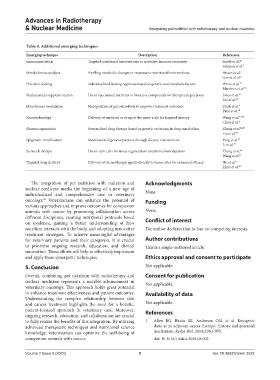
            Table 4. Additional emerging techniques
            Emerging technique                              Description                         References
            Immunonutrition           Targeted nutritional interventions to modulate immune responses  Smith et al. 26
                                                                                                Johnson et al. 9
            Metabolomics analysis     Profiling metabolic changes in response to nutritional interventions  Brown et al. 2
                                                                                                Garcia et al. 6
            Precision feeding         Individualized feeding regimens based on genetic and metabolic factors  White et al. 27
                                                                                                Martinez et al. 28
            Nutraceutical supplementation  Use of specialized nutrients or bioactive compounds for therapeutic purposes  Jones et al. 10
                                                                                                Lee et al. 29
            Microbiome modulation     Manipulation of gut microbiota to improve treatment outcomes  Clark et al. 5
                                                                                                Patel et al. 30
            Nanotechnology            Delivery of nutrients or drugs at the nano-scale for targeted therapy  Wang et al. 43,44
                                                                                                Chen et al. 4
            Pharmacogenomics          Personalized drug therapy based on genetic variations in drug metabolism  Zhang et al. 48,49
                                                                                                Liu et al. 38
            Epigenetic modification   Modulation of gene expression through dietary interventions  Yang et al. 47
                                                                                                Li et al. 37
            Stem cell therapy         Use of stem cells for tissue regeneration and immunomodulation  Zheng et al. 49
                                                                                                Wang et al. 43
            Targeted drug delivery    Delivery of chemotherapy agents directly to tumor sites for enhanced efficacy  Hu et al. 8
                                                                                                Zhou et al. 50


              The integration of pet nutrition with radiation and   Acknowledgments
            nuclear medicine marks  the beginning of a new age of
            individualized  and  comprehensive  care  in  veterinary   None.
            oncology.  Veterinarians can enhance the potential of   Funding
                   50
            various approaches and improve outcomes for companion
            animals with cancer by promoting collaboration across   None.
            different disciplines, creating nutritional protocols based
            on evidence, gaining a better understanding of how   Conflict of interest
            nutrition interacts with the body, and adopting innovative   The author declares that he has no competing interests.
            treatment strategies. To achieve meaningful advantages
            for  veterinary  patients  and their caregivers,  it is  crucial   Author contributions
            to prioritize ongoing research, education, and clinical   This is a single-authored article.
            innovation. These efforts will help to effectively implement
            and apply these synergistic techniques.            Ethics approval and consent to participate
            5. Conclusion                                      Not applicable.
            Overall, combining pet nutrition with radiotherapy and   Consent for publication
            nuclear medicine represents a notable advancement in   Not applicable.
            veterinary oncology. This approach holds great potential
            to enhance treatment effectiveness and patient outcomes.   Availability of data
            Understanding the complex relationship between diet
            and cancer treatment highlights the need for a holistic,   Not applicable.
            patient-focused approach in veterinary care. Moreover,   References
            ongoing research, education, and collaboration are crucial
            to fully realize the benefits of this integration. By utilizing   1.   Allen BG, Bhatia SK, Anderson CM,  et al. Ketogenic
            advanced therapeutic techniques and nutritional science   diets as an adjuvant cancer therapy: History and potential
            knowledge, veterinarians can optimize the well-being of   mechanism. Redox Biol. 2014;2:963-970.
            companion animals with cancer.                        doi: 10.1016/j.redox.2014.08.002


            Volume 2 Issue 3 (2024)                         9                              doi: 10.36922/arnm.3522

