


Page 13 - ARNM-2-3
P. 13
Advances in Radiotherapy
            & Nuclear Medicine                                   Integrating pet nutrition with radiotherapy and nuclear medicine


            cells while minimizing systemic toxicity. 23,24  Nutritional   and clinical advancements. 33,34  Longitudinal studies are
            interventions tailored to the unique metabolic requirements   needed to assess the effects of customized nutritional
            of pets undergoing targeted radionuclide therapies play a   interventions on treatment outcomes, side effects,
            crucial role in enhancing treatment efficacy, minimizing   and long-term survival in veterinary cancer patients
            radiation-induced toxicity, and promoting overall well-  undergoing targeted radionuclide therapies. Moreover,
            being. High-quality, nutrient-dense diets rich in protein   clarifying the underlying mechanisms of how nutrition
            and essential nutrients support tissue repair mechanisms,   reacts with targeted radionuclide therapies could provide
            enhance immune function,  and mitigate treatment-  insights for developing individualized nutrition plans and
                                   25
            related side effects, thereby optimizing treatment tolerance   additional treatments to enhance treatment efficacy and
            and improving patient outcomes. 12                 improve patient results.
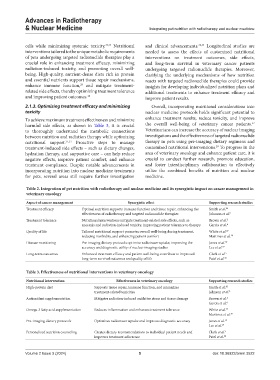
            2.1.3. Optimizing treatment efficacy and minimizing   Overall, incorporating nutritional considerations into
            toxicity                                           nuclear medicine protocols holds significant potential to
            To achieve maximum treatment effectiveness and minimize   enhance treatment results, reduce toxicity, and improve
                                                                                                            17
            harmful side  effects,  as  shown  in  Table  3,  it  is crucial   the  overall  well-being  of  veterinary  cancer  patients.
            to thoroughly understand the metabolic connections   Veterinarians can increase the accuracy of nuclear imaging
            between nutrition and radiation therapy while optimizing   investigations and the effectiveness of targeted radionuclide
            nutritional support. 31,32  Proactive steps to manage   therapy in pets using pre-imaging dietary regimens and
                                                                                             29
            treatment-induced side effects – such as dietary changes,   customized nutritional interventions.  To progress in the
            hydration therapy, and supportive care – can help reduce   area of veterinary oncology and enhance patient care, it is
            negative effects, improve patient comfort, and enhance   crucial to conduct further research, promote education,
            treatment compliance. Despite notable advancements in   and foster interdisciplinary collaboration to effectively
            incorporating nutrition into nuclear medicine treatments   utilize  the  combined  benefits  of  nutrition  and  nuclear
            for pets, several areas still require further investigation   medicine.

            Table 2. Integration of pet nutrition with radiotherapy and nuclear medicine and its synergistic impact on cancer management in
            veterinary oncology
            Aspect of cancer management                Synergistic effect                 Supporting research studies
            Treatment efficacy      Optimal nutrition supports immune function and tissue repair, enhancing the   Smith et al. 26
                                    effectiveness of radiotherapy and targeted radionuclide therapies  Johnson et al. 9
            Treatment tolerance     Nutritional interventions mitigate treatment-related side effects, such as   Brown et al. 2
                                    anorexia and radiation-induced toxicity, improving patient tolerance to therapy  Garcia et al. 6
            Quality of life         Tailored nutritional support promotes overall well-being during treatment,   White et al. 27
                                    reducing morbidity, and enhancing patient comfort     Martinez et al. 28
            Disease monitoring      Pre-imaging dietary protocols optimize radiotracer uptake, improving the   Jones et al. 10
                                    accuracy and diagnostic utility of nuclear imaging studies  Lee et al. 29
            Long-term outcomes      Enhanced treatment efficacy and patient well-being contribute to improved   Clark et al. 5
                                    long-term survival outcomes and quality of life       Patel et al. 30


            Table 3. Effectiveness of nutritional interventions in veterinary oncology
            Nutritional intervention              Effectiveness in veterinary oncology    Supporting research studies
            High-protein diet            Supports tissue repair, immune function, and minimizes   Smith et al. 26
                                         treatment-related toxicities                     Johnson et al. 9
            Antioxidant supplementation  Mitigates radiation-induced oxidative stress and tissue damage  Brown et al. 2
                                                                                          Garcia et al. 6
            Omega-3 fatty acid supplementation  Reduces inflammation and enhances treatment tolerance  White et al. 27
                                                                                          Martinez et al. 28
            Pre-imaging dietary protocols  Optimizes radiotracer uptake and improves diagnostic accuracy  Jones et al. 10
                                                                                          Lee et al. 29
            Personalized nutrition counseling  Creates dietary recommendations to individual patient needs and   Clark et al. 5
                                         improves treatment adherence                     Patel et al. 30


            Volume 2 Issue 3 (2024)                         5                              doi: 10.36922/arnm.3522

