


Page 50 - ARNM-2-3
P. 50
Advances in Radiotherapy
            & Nuclear Medicine                                                  Image-guided interventional radiotherapy


            and  alignment  of  the  source  applicator  according  to   5. CT-sim guided radioactive seed
            predetermined specifications. This evolution has propelled   implantation
            HDR-BT into a new era characterized by 3D treatment
            approaches,  with  CT-sim  scan  technology  playing  a   The CT-guided radioactive 125I seed implantation
            pivotal role. Typically, HDR-BT entails 4 – 6 sessions   brachytherapy utilizes imaging guidance techniques to
            administered biweekly over an extended therapy duration.   accurately position radioactive iodine-125 seed (with
            However, the repeated insertions of the source applicator   a half-life of 59.6  days, size of 0.8 × 4.5  mm, energy of
            may pose a risk of cross-contamination and compromise   27 – 35 keV, and encased in a nickel-titanium alloy) within
            patient tolerability. Attempts have been made to address   or around tumors. The precise emission of low-energy
            these challenges by converting the CT simulation room   gamma rays from iodine-125 seed effectively eradicates
            into an operating theater equipped with aseptic lighting   tumor cells. This approach is characterized by the delivery
            and imaging guidance devices, aligned with surgical   of localized high doses, rapid dose decay, and minimal
            standards requirements,  to minimize  nosocomial   damage to surrounding normal tissues, establishing it as
            infections. In addition, the concept of “no pain HDR-BT”   an internationally recognized standard for the treatment of
            was introduced, involving the utilization of an anesthesia   early-stage prostate cancer. 27-32
            pump to administer spinal or epidural anesthesia, ensuring   In 2001, Professor Junjie Wang spearheaded the
            optimal patient position comfort during treatment.   implementation of this technique in China with an initial
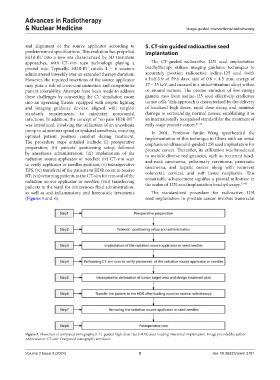
            The procedure steps entailed include (i) preoperative   emphasis on ultrasound-guided 125I seed implantation for
            preparation; (ii) patients’ positioning setup, followed   prostate cancer. Thereafter, its utilization was broadened
            by anesthesia administration; (iii) implantation of the   to include diverse malignancies, such as recurrent head-
            radiation source applicator or needles; (iv) CT-sim scan   and-neck carcinoma, pulmonary carcinoma, pancreatic
            to verify applicator or needles position; (v) intraoperative   carcinoma, and hepatic cancer along with recurrent
            TPS; (vi) transferal of the patients to HDR room to receive   colorectal, cervical, and soft tissue neoplasms. This
            RT; (vii) returning patients to the CT-sim for removal of the   remarkable  advancement  signifies  a  pivotal  milestone  in
            radiation source applicator or needles; (viii) transferring   the realm of 125I seed implantation brachytherapy. 33-45
            patients to the ward for intravenous fluid administration,
            as well as anti-inflammatory and hemostatic treatments   The standardized procedure for radioactive 125I
            (Figures 5 and  6).                                seed implantation in prostate cancer involves transrectal


            Figure 5. Flowchart of computed tomography (CT)-guided high-dose-rate (HDR) after-loading interstitial implantation. Image provided by author.
            Abbreviation: CT-sim: Computed tomography simulator.


            Volume 2 Issue 3 (2024)                         5                              doi: 10.36922/arnm.3781

