


Page 23 - ARNM-2-4
P. 23
Advances in Radiotherapy
            & Nuclear Medicine                                                68 Ga-PSMA PET CT/MRI in prostate cancer


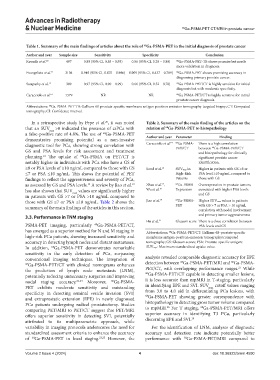
            Table 1. Summary of the main findings of articles about the role of  Ga-PSMA-PET in the initial diagnosis of prostate cancer
                                                              68
            Author and year  Sample size  Sensitivity         Specificity               Conclusion
            Kawada et al. 10  497    0.89 (95% CI, 0.85 – 0.93)  0.56 (95% CI, 0.29 – 0.80)  68 Ga-PSMA-PET-TB shows promise but needs
                                                                            more validation in diagnosis.
            Evangelista et al. 11  2104  0.949 (95% CI, 0.875 – 0.986) 0.909 (95% CI, 0.437 – 0.789)  68 Ga-PSMA-PET shows promising accuracy in
                                                                            diagnosing primary prostate cancer.
            Satapathy et al. 12  389  0.97 (95% CI, 0.90 – 0.99)  0.66 (95% CI, 0.52 – 0.78)  68 Ga-PSMA-PET/CT is highly sensitive for initial
                                                                            diagnosis but with moderate specificity.
            Caracciolo et al. 14  1379      NR                  NR          68 Ga PSMA-PET/CT is highly sensitive for initial
                                                                            prostate cancer diagnosis.
            Abbreviations:  Ga-PSMA-PET-TB: Gallium-68-prostate-specific membrane antigen-positron emission tomography-targeted biopsy; CT: Computed
                      68
            tomography; CI: Confidence interval.
              In a retrospective study by Pepe et al. , it was noted   Table 2. Summary of the main finding of the articles on the
                                              20
            that  an  SUV max  >8  indicated  the  presence  of  csPCa  with   relation of  Ga-PSMA-PET to histopathology
                                                                       68
            a false-positive rate of 4.8%. The use of  Ga-PSMA-PET   Author and year  Parameter  Finding
                                             68
            demonstrates promising potential as a non-invasive
                                                                             Ga PSMA-
            diagnostic tool for PCa, showing strong correlation with   Caracciolo et al. 14  68 PET/CT  There is a high correlation
                                                                                     between  Ga-PSMA-PET/CT
                                                                                           68
            GS and PSA levels for risk assessment and treatment                      and histopathology for clinically
            planning.  The uptake of  Ga-PSMA on PET/CT is                           significant prostate cancer
                   21
                                   68
            notably higher in individuals with PCa who have a GS of                  identification.
            ≥8 or PSA levels of ≥10 ng/mL compared to those with GS   Sood et al. 15  SUVmax in   Higher in patients with GS ≥8 or
            ≤7 or PSA ≤10 ng/mL. This shows the potential of PET            High-Risk   PSA level ≥10 ng/mL compared to
            findings to reflect the aggressiveness and severity of PCa,     Patients  those with GS
                                      15
            as assessed by GS and PSA levels.  A review by Jiao et al.    Zhao et al. ,    68 Ga-PSMA   Overexpression in prostate tumors,
                                                         19
                                                                      17
            has also shown that SUV  values are significantly higher   Wu et al. 18  Expression  associated with higher PSA levels
                                max
            in patients with GS >7 or PSA >10 ng/mL compared to                      and GS
            those with GS ≤7 or PSA ≤10 ng/mL. Table 2 shows the   Jiao et al. 19  68 Ga-PSMA-  Higher SUVmax values in patients
            summary of the main findings of the articles in this section.   PET      with GS > 7 or PSA > 10 ng/ml,
                                                                                     correlation with nodal involvement
            3.3. Performance in TNM staging                                          and primary tumor aggressiveness
                                                               Hu et al. 21  Gleason score There is a close correlation between
            PSMA-PET imaging, particularly  Ga-PSMA-PET/CT,                          PSA levels and GS
                                         68
            has emerged as a superior method for N and M staging in   Abbreviations:  Ga-PSMA-PET/CT: Gallium-68-prostate-specific
                                                                         68
            high-risk PCa patients, showing increased sensitivity and   membrane antigen-positron emission tomography/computed
            accuracy in detecting lymph nodes and distant metastases.   tomography; GS: Gleason scores; PSA: Prostate-specific antigen;
            In addition,  Ga-PSMA-PET demonstrates remarkable   SUVmax: Maximum standardized uptake value.
                       68
            sensitivity in the early detection of PCa, surpassing
            conventional imaging techniques. The integration of   analysis revealed comparable diagnostic accuracy for EPE
                                                                              68
                                                                                                   68
            68 Ga-PSMA-PET/CT with clinical nomograms enhances   detection between  Ga-PSMA-PET/MRI and  Ga-PSMA-
                                                                                                      23
            the prediction of lymph node metastasis (LNM),     PET/CT, with overlapping performance ranges.  While
                                                               68
            potentially reducing unnecessary surgeries and improving   Ga-PSMA-PET/CT capable in detecting smaller lesions,
            nodal staging accuracy. 22-24  Moreover,   68 Ga-PSMA-  it is less accurate than mpMRI in T-staging, particularly
            PET exhibits moderate sensitivity and outstanding   in identifying EPE and SVI. SUV  cutoff values ranging
                                                                                          max
            specificity in detecting seminal vesicle invasion (SVI)   from 3.0 to 4.0 aid in differentiating PCa lesions, with
                                                               68
            and extraprostatic extension (EPE) in newly diagnosed   Ga-PSMA-PET showing greater correspondence with
            PCa  patients  undergoing  radical  prostatectomy.  Studies   histopathology in detecting gross tumor volume compared
                                                                        26
                                                                                      68
            comparing PET/MRI to PET/CT suggest that PET/MRI   to mpMRI.  For T staging,  Ga-PSMA-PET/MRI offers
            offers superior sensitivity in detecting SVI, potentially   superior accuracy in identifying T3  PCa, particularly
                                                                                   19
            attributed to its multiparametric approach, while   discerning EPE and SVI.
            variability in imaging protocols underscores the need for   For the identification of LNM, analyses of diagnostic
            standardized assessment criteria to enhance the accuracy   accuracy and detection rate indicate potentially better
            of  Ga-PSMA-PET  in local  staging. 23,25  However, the   performance with  Ga-PSMA-PET/MRI compared to
               68
                                                                               68
            Volume 2 Issue 4 (2024)                         4                              doi: 10.36922/arnm.4590

