


Page 25 - ARNM-2-4
P. 25
Advances in Radiotherapy
            & Nuclear Medicine                                                68 Ga-PSMA PET CT/MRI in prostate cancer


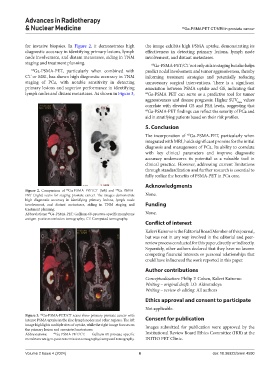
            for invasive  biopsies.  In  Figure  2,  it  demonstrates high   the image exhibits high PSMA uptake, demonstrating its
            diagnostic accuracy in identifying primary lesions, lymph   effectiveness in detecting primary lesions, lymph node
            node involvement, and distant metastases, aiding in TNM   involvement, and distant metastases.
            staging and treatment planning.                      68 Ga-PSMA-PET/CT not only aids in staging but also helps
              68 Ga-PSMA-PET, particularly when combined with   predict nodal involvement and tumor aggressiveness, thereby
            CT or MRI, has shown high diagnostic accuracy in TNM   informing treatment strategies and potentially reducing
            staging of PCa, with notable sensitivity in detecting   unnecessary surgical interventions. There is a significant
            primary lesions and superior performance in identifying   association between PSMA uptake and GS, indicating that
            lymph nodes and distant metastases. As shown in Figure 3,   68 Ga-PSMA PET can serve as a predictive tool for tumor
                                                               aggressiveness and disease prognosis. Higher SUV  values
                                                                                                      max
                                                               correlate with elevated GS and PSA levels, suggesting that
                                                               68 Ga-PSMA-PET findings can reflect the severity of PCa and
                                                               aid in stratifying patients based on their risk profiles.

                                                               5. Conclusion
                                                               The incorporation of  Ga-PSMA-PET, particularly when
                                                                                 68
                                                               integrated with MRI, holds significant promise for the initial
                                                               diagnosis and management of PCa. Its ability to correlate
                                                               with  key clinical  parameters  and  improve diagnostic
                                                               accuracy underscores its potential as a valuable tool in
                                                               clinical practice. However, addressing current limitations
                                                               through standardization and further research is essential to
                                                               fully realize the benefits of PSMA-PET in PCa care.
                                                               Acknowledgments
            Figure  2. Comparison of  Ga-PSMA PET/CT (left) and  Ga-PSMA-
                                                  68
                             68
            PET (right) scans for staging prostate cancer. The images demonstrate   None.
            high  diagnostic  accuracy in  identifying primary lesions,  lymph  node
            involvement,  and  distant  metastases,  aiding  in  TNM  staging  and   Funding
            treatment planning.
            Abbreviations:  Ga-PSMA-PET: Gallium-68-prostate-specific membrane   None.
                     68
            antigen-positron emission tomography; CT: Computed tomography.
                                                               Conflict of interest
                                                               Kalevi Kairemo is the Editorial Board Member of this journal,
                                                               but was not in any way involved in the editorial and peer-
                                                               review process conducted for this paper, directly or indirectly.
                                                               Separately, other authors declared that they have no known
                                                               competing financial interests or personal relationships that
                                                               could have influenced the work reported in this paper.

                                                               Author contributions
                                                               Conceptualization: Philip F. Cohen, Kalevi Kairemo
                                                               Writing – original draft: I.O. Akinmuleya
                                                               Writing – review & editing: All authors

                                                               Ethics approval and consent to participate
                                                               Not applicable.
            Figure 3.  Ga-PSMA-PET/CT scans show primary prostate cancer with
                  68
            intense PSMA uptake in the iliac lymph nodes and other regions. The left   Consent for publication
            image highlights multiple sites of uptake, while the right image focuses on   Images submitted for publication were approved by the
            the primary lesion and associated metastases.
            Abbreviations:   68 Ga-PSMA-PET/CT:  Gallium-68-prostate-specific  Institutional Review Board Ethics Committee (IRB) at the
            membrane antigen-positron emission tomography/computed tomography.  INITIO PET Clinic.


            Volume 2 Issue 4 (2024)                         6                              doi: 10.36922/arnm.4590

