


Page 58 - ARNM-2-4
P. 58
Advances in Radiotherapy
            & Nuclear Medicine                                                      Efficacy of stereotactic radiotherapy


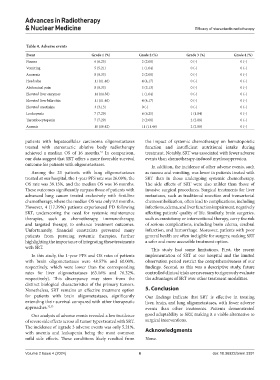
            Table 4. Adverse events
            Event                       Grade 1 (%)         Grade 2 (%)         Grade 3 (%)         Grade 4 (%)
            Nausea                       6 (6.25)            2 (2.08)             0 (-)                0 (-)
            Vomiting                     5 (5.21)            1 (1.04)             0 (-)                0 (-)
            Anorexia                     8 (8.33)            2 (2.08)             0 (-)                0 (-)
            Headache                     11 (11.46)          4 (4.17)             0 (-)                0 (-)
            Abdominal pain               8 (8.33)            3 (3.13)             0 (-)                0 (-)
            Elevated liver enzymes       14 (14.58)          1 (1.04)             0 (-)                0 (-)
            Elevated liver bilirubin     11 (11.46)          4 (4.17)             0 (-)                0 (-)
            Elevated creatinine          3 (3.13)            0 (-)                0 (-)                0 (-)
            Leukopenia                   7 (7.29)            6 (6.25)             1 (1.04)             0 (-)
            Thrombocytopenia             7 (7.29)            2 (2.08)             2 (2.08)             0 (-)
            Anemia                       10 (10.42)          11 (11.46)           2 (2.08)             0 (-)


            patients with hepatocellular carcinoma oligometastases   the impact of systemic chemotherapy on hematopoietic
            treated  with  stereotactic  ablative  body  radiotherapy   function and insufficient nutritional intake during
            achieved a median OS of 16  months.  In comparison,   treatment. Notably, SRT was associated with fewer adverse
                                            31
            our data suggest that SRT offers a more favorable survival   events than chemotherapy-induced myelosuppression.
            outcome for patients with oligometastases.           In addition, the incidence of other adverse events, such
              Among the 23  patients with lung oligometastases   as nausea and vomiting, was lower in patients treated with
            treated at our hospital, the 1-year PFS rate was 26.09%, the   SRT than in those undergoing systemic chemotherapy.
            OS rate was 39.13%, and the median OS was 16 months.   The side effects of SRT were also milder than those of
            These outcomes significantly surpass those of patients with   invasive surgical procedures. Surgical treatments for liver
            advanced lung cancer treated exclusively with first-line   metastases, such as traditional resection and transarterial
            chemotherapy, where the median OS was only 9.1 months.   chemoembolization, often lead to complications, including
            However,  4  (17.39%)  patients experienced PD  following   infections, edema, and liver function impairment, negatively
            SRT,  underscoring  the  need  for systemic  maintenance   affecting patients’ quality of life. Similarly, brain surgeries,
            therapies, such as chemotherapy, immunotherapy,    such as craniotomy or interventional therapy, carry the risk
            and targeted therapy, to enhance treatment outcomes.   of serious complications, including brain edema, cerebral
            Unfortunately, financial constraints prevented many   infarction, and hemorrhage. Moreover, patients with poor
            patients from pursuing systemic therapies, further   general health are often ineligible for surgery, making SRT
            highlighting the importance of integrating these treatments   a safer and more accessible treatment option.
            with SRT.                                            This study had some limitations. First, the recent
              In this study, the 1-year PFS and OS rates of patients   implementation of SRT at our hospital and the limited
            with brain oligometastases were 48.57% and 60.00%,   observation period restrict the comprehensiveness of our
            respectively, which were lower than the corresponding   findings. Second, as this was a descriptive study, future
            rates for liver oligometastases (63.16% and 76.32%,   controlled clinical trials are necessary to rigorously evaluate
            respectively). This discrepancy may stem from the   the advantages of SRT over other treatment modalities.
            distinct biological characteristics of the primary tumors.
            Nonetheless, SRT remains an effective treatment option   5. Conclusion
            for patients with brain oligometastases, significantly   Our findings indicate that SRT is effective in treating
            extending their survival compared with other therapeutic   liver, brain, and lung oligometastases, with fewer adverse
            approaches. 32,33                                  events than other treatments. Patients demonstrated
              Our analysis of adverse events revealed a low incidence   good adaptability to SRT, making it a viable alternative to
            of severe side effects across all tumor types treated with SRT.   surgical interventions.
            The incidence of ≥grade 3 adverse events was only 5.21%,
            with anemia and leukopenia being the most common   Acknowledgments
            mild side effects. These conditions likely resulted from   None.


            Volume 2 Issue 4 (2024)                         6                              doi: 10.36922/arnm.3391

