


Page 55 - ARNM-2-4
P. 55
Advances in Radiotherapy
            & Nuclear Medicine                                                      Efficacy of stereotactic radiotherapy


            response (CR), partial response (PR), stable disease (SD),   Table 1. Patient characteristics
            or progressive disease (PD). The objective response rate
            (ORR) was calculated as CR + PR divided by the total   Characteristic                  Total (n = 96)
            number of patients. The disease control rate (DCR) was   Sex
            calculated as CR + PR + SD divided by the total number   Male                           70 (72.92%)
            of patients.                                        Female                              26 (27.08%)
              Progression-free survival (PFS) was defined as the time   Age (years)
            from SRT to disease progression or death, whereas OS was   ≤60                          61 (63.54%)
            defined as the duration from the initiation of SRT to death   >60                       35 (36.46%)
            from any cause.                                    ECOG PS
            2.4. Endpoints and statistical analysis             0                                   42 (43.75%)
                                                                1                                   40 (41.67%)
            The primary endpoints of the study were tumor response,
            OS, and PFS. The secondary endpoint was acute toxicity,   2                             14 (14.58%)
            which was defined as adverse events occurring from the   Oligometastases (SRT for organ)
            beginning of SRT to 3  months after treatment. Acute   Liver                            38 (39.58%)
            toxicity was assessed based on the Common Terminology   Lung                            23 (23.96%)
            Criteria for Adverse Events version 5.0.            Brain                               35 (36.46%)
              All statistical analyses were performed using IBM SPSS   Primary tumor
            Statistics for Windows, version 27.0 (IBM Corp., Armonk,   Lung                         46 (47.92%)
            NY, USA). Patient characteristics and 3-month treatment   Liver                         31 (32.29%)
            outcomes were reported as frequencies and percentages.   Alimentary tract               7 (7.29%)
            Tumor response comparisons were conducted using the   Others                            12 (12.50%)
            Ward algorithm in a single-sample proportional test.
                                                               Tumor histology
            3. Results                                          Hepatocellular carcinoma            31 (32.29%)
            3.1. Patient characteristics                        Adenocarcinoma                      44 (45.83%)
                                                                Squamous cell carcinoma             7 (7.29%)
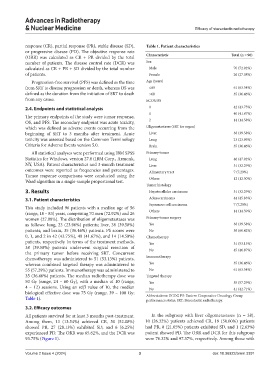
            This study included 96 patients with a median age of 56
            (range, 18 – 83) years, comprising 70 men (72.92%) and 26   Others                      14 (14.59%)
            women (27.08%). The distribution of oligometastases was   Primary tumor surgery
            as follows: lung, 23 (23.96%) patients; liver, 38 (39.58%)   Yes                        38 (39.58%)
            patients; and brain, 35 (36.46%) patients. PS scores were   No                          58 (60.42%)
            0, 1, and 2 in 42 (43.75%), 40 (41.67%), and 14 (14.58%)   Chemotherapy
            patients, respectively. In terms of the treatment methods,   Yes                        51 (53.13%)
            38  (39.58%) patients underwent surgical resection of   No                              45 (46.87%)
            the primary tumor before receiving SRT. Concurrent
            chemotherapy was administered to 51 (53.13%) patients,   Immunotherapy
            whereas combined targeted therapy was administered to   Yes                             35 (36.46%)
            55 (57.29%) patients. Immunotherapy was administered to   No                            61 (63.54%)
            35 (36.46%) patients. The median radiotherapy dose was   Targeted therapy
            50 Gy (range, 24 – 60 Gy), with a median of 10 (range,   Yes                            55 (57.29%)
            4 – 12) sessions. Using an  α/β value of 10, the median   No                            41 (42.71%)
            biological effective dose was 75 Gy (range, 39 – 100 Gy;   Abbreviations: ECOG PS: Eastern Cooperative Oncology Group
            Table 1).                                          performance status; SRT: Stereotactic radiotherapy.

            3.2. Efficacy outcomes
            All patients survived for at least 3 months post-treatment.   In the subgroup with liver oligometastases (n = 38),
            Among  them,  13  (13.54%)  achieved  CR,  50  (52.08%)   10  (26.32%) patients achieved CR, 19  (50.00%) patients
            showed PR, 27  (28.13%) exhibited SD, and 6  (6.25%)   had PR, 8 (21.05%) patients exhibited SD, and 1 (2.63%)
            experienced PD. The ORR was 65.62%, and the DCR was   patient showed PD. The ORR and DCR for this subgroup
            93.75% (Figure 1).                                 were 76.32% and 97.37%, respectively. Among those with


            Volume 2 Issue 4 (2024)                         3                              doi: 10.36922/arnm.3391

