


Page 101 - ARNM-3-1
P. 101
Advances in Radiotherapy
            & Nuclear Medicine                                                 PET/CT in B-cell non-Hodgkin’s lymphoma


            immunohistochemistry,  ultrasonography,  computed  Table 1. Patients’ characteristics
            tomography,  and   18 fluoro-2-deoxy-d-glucose positron
            emission tomography/computed tomography (18FDG     Parameters  Category     Number (n=86)  Percentage
            PET/CT).                                           Sex         Male              48         55.8
                                                                           Female            38         44.2
              Most patients with NHLs have increased glucose
            metabolism; thus, whole-body PET/CT with   18 FDG   Pathological   Rapid progression  72    83.7
                                                               classification
            provides molecular-level metabolic images by PET and can       Slow progression   14        16.3
            be combined with anatomical images by CT. Consequently,   Stage before   I       26         30.2
            it can accurately detect lesions in tumors and lymph   PET/CT  II                29         33.7
            nodes with a much higher sensitivity and specificity than      III               15         17.4
            conventional imaging methods. Compared with other              IV                16         18.7
            imaging methods, PET/CT can assess the NHL stage more   Stage after   I          19         22.1
            accurately. Reportedly,  FDG PET/CT has sensitivity and   PET/CT
                              18
            specificity up to 99%–100% in diagnosing B-cell NHL            II                23         26.8
            stage.  Therefore, this study aimed to fully evaluate the role   III             18         20.9
                2
            of  FDG PET/CT in B-cell NHL.                                  IV                26         30.2
              18
                                                               Changing stage  Unchanged     65         75.6
            2. Methods                                                     Increased stage*  21         24.4
            In this retrospective descriptive study, 86  patients          Decreased stage**  0          0
            newly diagnosed with B-cell NHL who had not        Notes: *Increased stage: upstaging is the presence of additional suspicious
            previously been treated were histopathologically and   lesions on PET/CT compared with other imaging methods that changes
            immunohistochemically examined at Hanoi  Oncology   the stage per Ann Arbor classification. The criterion for determining a
                                                                                            18
            Hospital between January 2018 and December 2022.   positive PET/CT result is the presence of focal  FDG increased uptake as
                                                               determined by standard uptake value (SUV) and/or lymph nodes on CT
            Patients with severe diseases, two or more types of cancer,   measuring ≥10 mm. SUV of 2.5 is the diagnostic threshold, distinguishing
            and high blood sugar ≥11.1 mmol/L before PET/CT,   between benign and malignant lesions. **Decreased stage: downstaging
            did not agree to participate in the study, and those with   is defined as lesions that are suspicious on other imaging methods but not
            incomplete information were excluded.              on PET/CT, which change the stage per Ann Arbor classification.
                                                                        18
                                                               Abbreviation:  FDG: 18fluoro-2-deoxy-d-glucose; PET/CT: Positron
              Patients fasted for at least 6 h before the scan. Patients   emission tomography/computed tomography.
            with blood glucose levels before the scan that did not
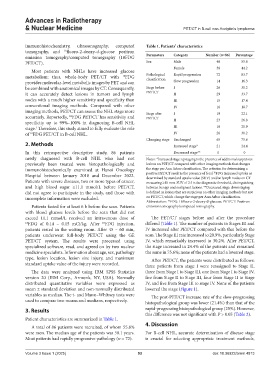
            exceed  11.1 mmol/L received an intravenous dose of   The PET/CT stages before and after the procedure
            18 FDG  of 0.14  – 0.15 mCi/kg. After  FDG injection,   differed (Table 1). The number of patients in Stages III and
                                             18
            patients  rested  in  the  waiting  room.  After  45  – 60  min,   IV increased after PET/CT compared with that before the
            patients underwent full-body PET/CT using the GE   scan. The Stage III rate increased to 20.9%, particularly Stage
            PET/CT system. The results were processed using    IV, which remarkably increased to 30.2%. After PET/CT,
            specialized software, read, and agreed on by two nuclear   the stage increased in 24.4% of the patients and remained
            medicine specialists. Information about age, sex, pathology   the same in 75.6%; none of the patients had a lowered stage.
            type, lesion location, lesion size injury, and maximum   After PET/CT, the patients were distributed as follows:
            standard uptake value of the injury were recorded.  three patients from stage I were reassigned to Stage II,
              The data were analyzed using IBM SPSS  Statistics   three from Stage I to Stage III, one from Stage I to Stage IV,
            version  20 (IBM Corp., Armonk, NY, USA). Normally   five from Stage II to Stage III, four from Stage II to Stage
            distributed  quantitative  variables  were  expressed  as   IV, and five from Stage III to stage IV. None of the patients
            mean ± standard deviation and non-normally distributed   lowered the stage (Figure 1).
            variables as median. The t- and Mann–Whitney tests were   The post-PET/CT increase rate of the slow-progressing
            used to compare two means and medians, respectively.  histopathological group was lower (21.4%) than that of the

            3. Results                                         rapid-progressing histopathological group (25%). However,
                                                               this difference was not significant with P > 0.05 (Table 2).
            Patient characteristics are summarized in Table 1.
                                                               4. Discussion
              A total of 86 patients were recruited, of whom 55.8%
            were men. The median age of the patients was 58.1 years.   For B-cell NHL, accurate determination of disease stage
            Most patients had rapidly progressive pathology (n = 72).  is crucial for selecting appropriate treatment methods,


            Volume 3 Issue 1 (2025)                         93                             doi: 10.36922/arnm.4813

