


Page 106 - ARNM-3-1
P. 106
Advances in Radiotherapy
            & Nuclear Medicine                                                 Role of 18F-FDG in brown tumor detection


            Following conservative treatment, an increase in CA15-3   showed a total calcium level of 116 mg/L (reference range:
            levels at 73 U/mL (reference value <31.3 U/mL) and   80 – 105 mg/L) and a phosphorus level of 42 mg/L (reference
            diffuse bone pain in 2018 suggested metastatic recurrence.   range: 25 – 50  mg/L). The PTH level was abnormally
            Bone scintigraphy indicated metabolic super scan with   elevated at 1214 pg/mL (reference range: 15 – 68 pg/mL),
            heterogeneous uptake in the skull. In addition to mediastinal   confirming the diagnosis of secondary HPT. A cervical
            and left internal mammary lymph node involvement, a CT   ultrasound revealed a centimetric retrothyroid left mid-
            scan revealed lytic lesions in the spine, sternum, and pelvic   lobe nodular formation suggestive of a parathyroid nodule
            bones. PET-CT scan showed metabolically active metastatic   at this level. Whole-body scan with 99mTc-MIBI show
            lesions in the left lung, liver segment IV, mediastinal lymph   no definite suspicious focus suggestive of brown tumors,
            nodes, and left internal mammary chain. Bone lesions   except for physiological radiopharmaceutical uptake in
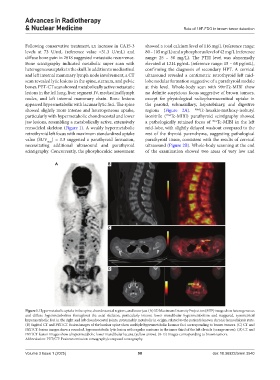
            appeared hypermetabolic with lacunar lytic foci. The spine   the  parotid,  submaxillary,  hepatobiliary,  and  digestive
            showed slightly more intense and heterogeneous uptake,   regions (Figure 2A).   99m Tc-hexakis-methoxy-isobutyl
            particularly with hypermetabolic chondrocostal and lower   isonitrile  ( Tc-MIBI)  parathyroid  scintigraphy  showed
                                                                        99m
            jaw lesions, resembling a metabolically active, extensively   a pathologically retained focus of   99m Tc-MIBI in the left
            remodeled skeleton (Figure 1). A weakly hypermetabolic   mid-lobe, with slightly delayed washout compared to the
            retrothyroid left focus with maximum standardized uptake   rest of the thyroid parenchyma, suggesting pathological
            value (SUV ) = 3.3 suggested a parathyroid formation,   parathyroid tissue, consistent with the results of cervical
                     max
            necessitating additional ultrasound and parathyroid   ultrasound (Figure 2B). Whole-body scanning at the end
            scintigraphy. Concurrently, the phosphocalcic assessment   of the  examination  showed two  areas of very low and


                         A                     B


                                               C


                                               D


            Figure 1. Hypermetabolic uptake in the spine, chondrocostal regions, and lower jaw. (A) 3D Maximum Intensity Projection (MIP) image show heterogeneous
            and diffuse hypermetabolism throughout the axial skeleton, particularly intense lower mandibular hypermetabolism and staggered, symmetrical
            hypermetabolic foci in the right and left chondrocostal joints, presumably metabolic in origin, related to the patient’s known chronic hemodialysis state.
            (B) Sagittal CT and PET/CT fusion images of the lumbar spine show multiple hypermetabolic lacunar foci corresponding to brown tumors. (C) CT and
            PET/CT fusion images show a rounded, hypermetabolic lytic lesion with regular contours in the inner third of the left clavicle (orange arrow). (D) CT and
            PET/CT fusion images show a hypermetabolic lower mandibular lacuna (yellow arrow). (B-D) Images corresponding to brown tumors.
            Abbreviation: PET/CT: Positron emission tomography/computed tomography.


            Volume 3 Issue 1 (2025)                         98                             doi: 10.36922/arnm.3540

