


Page 108 - ARNM-3-1
P. 108
Advances in Radiotherapy
            & Nuclear Medicine                                                 Role of 18F-FDG in brown tumor detection


             A                 B                               in their description. Additional imaging modalities, such
                                                               as CT, MRI, and/or PET/CT become necessary in cases
                                                               of diagnostic uncertainty, multifocality, or involvement of
                                                               adjacent soft tissues.
                                                                 In general,   99m Tc-MIBI scintigraphy remains the gold
                                                               standard for pre-operative localization of hyperfunctional
                                                               parathyroid lesions in primary, secondary, or tertiary HPT.
                                                                                                             4
                                                               In cases of known bone lesions, it is feasible to combine
                                                               cervical and mediastinal exploration with a whole-body
                               C
                                                               analysis, which allows mapping of the lesions throughout
                                                               the skeleton in a single examination.  In a study by
                                                                                               5
                                                               Zhao and Wang,  whole-body   99m Tc-MIBI  scintigraphy
                                                               performed in the context of primary (63  patients) and
                                                               secondary (16 patients) HPT showed bone hyperfixations
                                                               corresponding to brown tumors in 4% of cases (3/79). These
                                                               hyperfixations are not constant, differ from one patient to
                                                               another, and are not specific to brown tumors but reflect bone
                                                               hypermetabolism related to osteoclastic cell proliferation.
                                                                                                             6
                                                               The radiopharmaceutical accumulates in mitochondrial
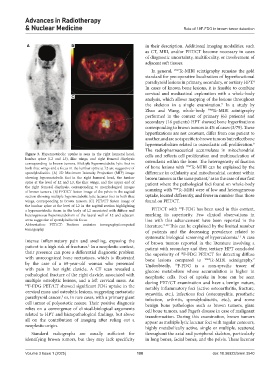
            Figure  3.  Hypermetabolic uptake is seen in the right humeral head,   cells and reflects cell proliferation and multinucleation of
            lumbar spine (L2 and L3), iliac wings, and right femoral diaphysis   osteoclasts within the bone. The heterogeneity of fixation
            corresponding to brown tumors. Multiple hypermetabolic lytic foci in
            both iliac wings and a focus in the lumbar spine at L2 are suggestive of   of bone lesions with   99m Tc-MIBI can be explained by the
            spondylodiscitis. (A) 3D Maximum Intensity Projection (MIP) image   difference in cellularity and mitochondrial content within
            showing hypermetabolic foci in the right humeral head, the lumbar   brown tumors in the same patient,  as in the case of our first
                                                                                          7
            spine at the level of L2 and L3, the iliac wings, and the upper end of   patient where the pathological foci found on whole-body
            the right femoral diaphysis, corresponding to morphological images   scanning with  99m Tc-MIBI were of low and heterogeneous
            of brown tumors. (B) PET/CT fusion image of the pelvis in the sagittal
            section showing multiple hypermetabolic lytic lacunar foci in both iliac   uptake, located differently, and fewer in number than those
            wings,  corresponding to brown tumors. (C) PET/CT  fusion image of   found on PET/CT.
            the lumbar spine at the level of L2 in the sagittal section highlighting   18
            a  hypermetabolic  focus  in  the  body  of  L2  associated  with  diffuse  and   PET/CT with  F-FDG has been used in this context,
            heterogeneous hypermetabolism of the lateral wall of L2 and adjacent   marking its superiority. Few clinical observations in
            areas suggestive of spondylodiscitis focus.        line with this advancement have been reported in the
            Abbreviation: PET/CT: Positron emission tomography/computed   literature. 7-10  This can be explained by the limited number
            tomography.
                                                               of patients and the decreasing prevalence related to
                                                               systematic biological screening of hypercalcemia.  A case
                                                                                                      11
            intense inflammatory pain and swelling, exposing the   of brown tumors reported in the literature involving a
            patient to a high risk of fractures.  In a neoplastic context,   patient with secondary and then tertiary HPT concluded
                                       1
            their presence can pose a differential diagnostic problem   the superiority of  F-FDG PET/CT for detecting diffuse
                                                                              18
            with unrecognized bone metastases, which is illustrated   bone lesions compared to   99m Tc-MIBI scintigraphy.
                                                                                                             7
            by the case of a 69-year-old woman who presented   Undoubtedly,   18 F-FDG is a non-specific tracer of
            with pain in her right clavicle. A  CT scan revealed a   glucose metabolism whose accumulation is higher in
            pathological fracture of the right clavicle, associated with   neoplastic cells. Foci of uptake in bone can be seen
            multiple osteolytic lesions, and a left cervical mass. An   during  PET/CT  examination  and  have  a  benign  nature,
            18 F-FDG PET/CT showed significant FDG uptake in the   notably inflammatory foci (active osteoarthritis, fracture,
            cervical mass and osteolytic lesions, suggesting metastatic   synovitis, etc.), infectious foci (osteomyelitis, prosthetic
            parathyroid cancer,  or, in rare cases, with a primary giant   infection, arthritis, spondylodiscitis, etc.), and some
                           3
            cell tumor of polyostotic nature. Their positive diagnosis   benign bone pathologies such as brown tumors, giant
            relies on a convergence of clinical-biological arguments   cell bone tumors, and Paget’s disease in case of malignant
            related to HPT and histopathological findings, but above   transformation. During this examination, brown tumors
            all  on  the  contribution  of  imaging  after  ruling  out  a   appear as multiple lytic lacunar foci with regular contours,
            neoplastic origin.                                 highly metabolically active, single or multiple, scattered
              Standard radiographs are usually sufficient for   throughout the axial and peripheral skeleton, particularly
            identifying brown tumors, but they may lack specificity   in long bones, facial bones, and the pelvis. These lacunar


            Volume 3 Issue 1 (2025)                        100                             doi: 10.36922/arnm.3540

