


Page 112 - ARNM-3-1
P. 112
Advances in Radiotherapy
            & Nuclear Medicine                                         18 F-FDG PET & unexplained inflammatory syndromes


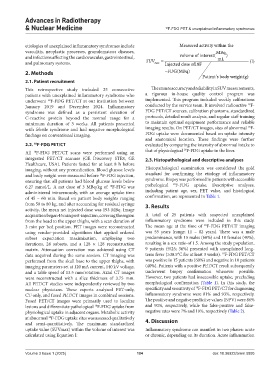
            etiologies of unexplained inflammatory syndromes include         Measured activity within the
            vasculitis, neoplastic processes, granulomatous diseases,                        MBq
            and infections affecting the cardiovascular, gastrointestinal,   volume of interest (  mL  )
            and pulmonary systems.                             SUV max  =  Injected dose of1  8F           (I)
            2. Methods                                                 −FDG (MBq)
                                                                                       Patient’s body weight (g)
            2.1. Patient recruitment
            This retrospective study included 25 consecutive     The ensure accuracy and reliability in SUV measurements,
            patients with unexplained inflammatory syndrome who   a rigorous in-house quality control program was
            underwent  F-FDG PET/CT at our institution between   implemented. This program included weekly calibrations
                     18
                                                                                                          18
            January 2019 and December 2024. Inflammatory       conducted by the service team. It involved radioactive  F-
            syndrome was defined as a persistent elevation of   FDG PET/CT sources, calibration phantoms, standardized
            C-reactive protein beyond the normal range for a   protocols, detailed result analysis, and regular staff training
            minimum duration of 3  weeks. All patients presented   to maintain optimal equipment performance and reliable
                                                                                                          18
            with febrile syndrome and had negative morphological   imaging results. On PET/CT images, sites of abnormal  F-
            findings on conventional imaging.                  FDG uptake were documented based on uptake intensity
                                                               and anatomical location. These findings were further
            2.2.  F-FDG PET/CT                                 evaluated by comparing the intensity of abnormal intake to
               18
                                                                               18
            All  F-FDG PET/CT scans were performed using an    that of physiological  F-FDG uptake in the liver.
               18
            integrated PET/CT scanner (GE Discovery STE8, GE   2.3. Histopathological and descriptive analyses
            Healthcare, USA). Patients fasted  for at least  8  h before
            imaging, without any premedication. Blood glucose levels   Histopathological  examination  was  considered  the  gold
            and body weight were measured before  F-FDG injection,   standard for confirming the etiology  of  inflammatory
                                           18
            ensuring that all patients had blood glucose levels below   syndrome. Biopsy was performed in patients with accessible
            6.27 mmol/L. A  net dose of 3 MBq/kg of  F-FDG was   pathological   18 F-FDG uptake. Descriptive analyses,
                                                18
            administered intravenously, with an average uptake time   including patient age, sex, PET value, and histological
            of 45 – 60  min. Based on patient body weights ranging   confirmation, are represented in Table 1.
            from 50 to 80 kg, and after accounting for residual syringe   3. Results
            activity, the mean net injected dose was 193 MBq. Image
            acquisition began 45 min post-injection, covering the region   A total of 25  patients with suspected unexplained
            from the head to the upper thighs, with a scan duration of   inflammatory syndrome were included in this study.
            3 min per bed position. PET images were reconstructed   The mean age at the time of  F-FDG PET/CT imaging
                                                                                        18
            using  vendor-provided  algorithms  that  applied  ordered   was  55  years  (range:  11  –  82  years).  There  was  a  male
            subset expectation maximization, employing two     predominance, with 15 males (60%) and 10 females (40%),
            iterations, 28  subsets, and a 128 × 128 reconstruction   resulting in a sex ratio of 1.5. Among the study population,
            matrix. Attenuation correction was achieved using CT   9  patients (9/25; 36%) presented with unexplained long-
                                                                                               18
            data acquired during the same session. CT imaging was   term fever (≥38.5°C for at least 3 weeks).  F-FDG PET/CT
            performed from the skull base to the upper thighs, with   was positive in 15 patients (60%) and negative in 10 patients
            imaging parameters set at 120 mA current, 140 kV voltage,   (40%). Patients with a positive PET/CT result subsequently
            and a table speed of 13.5 mm/rotation. Axial CT images   underwent biopsy confirmation whenever possible.
            were reconstructed with a slice thickness of 3.75  mm.   However, two patients had inaccessible uptake, precluding
            All PET/CT studies were independently reviewed by two   morphological confirmation (Table 1). In this study, the
                                                                                    18
            nuclear physicians. These experts analyzed PET-only,   specificity and sensitivity of  F-FDG PET/CT for diagnosing
            CT-only, and fused PET/CT images in combined sessions.   inflammatory syndrome were 81% and 93%, respectively.
            Fused PET/CT images were primarily used to localize   The positive and negative predictive values (NPV) were 86%
            lesions and differentiate pathological  F-FDG uptake from   and 90%, respectively, while the false-positive and false-
                                         18
            physiological uptake in adjacent organs. Metabolic activity   negative rates were 7% and 19%, respectively (Table 2).
            at abnormal  F-FDG uptake sites was assessed qualitatively
                      18
            and semi-quantitatively. The maximum standardized   4. Discussion
            uptake value (SUVmax) within the volume of interest was   Inflammatory syndrome can manifest in two phases: acute
            calculated using Equation I:                       or chronic, depending on its duration. Acute inflammation


            Volume 3 Issue 1 (2025)                        104                             doi: 10.36922/arnm.5895

