


Page 115 - ARNM-3-1
P. 115
Advances in Radiotherapy
            & Nuclear Medicine                                         18 F-FDG PET & unexplained inflammatory syndromes


                         A                      B                       C


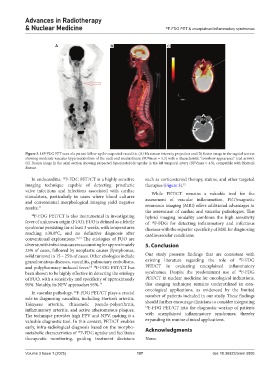
            Figure 3. 18F-FDG PET scan of a patient follow-up for suspected vasculitis. (A) Maximum intensity projection and (B) fusion image in the sagittal section
            showing moderate vascular hypermetabolism of the neck and mediastinum (SUVmax = 5.3) with a characteristic “crossbow appearance” (red arrow).
            (C) Fusion image in the axial section showing suspected hypermetabolic uptake in the left temporal artery (SUVmax = 4.5), compatible with Horton’s
            disease.

              In endocarditis,  F-FDG PET/CT is a highly sensitive   such as corticosteroid therapy, statins, and other targeted
                            18
            imaging  technique  capable  of  detecting  prosthetic   therapies (Figure 3). 15
            valve infections and infections associated with cardiac   While PET/CT remains a valuable tool for the
            stimulators, particularly in cases where blood cultures   assessment of vascular inflammation, PET/magnetic
            and conventional morphological imaging yield negative
            results. 11                                        resonance imaging (MRI) offers additional advantages in
                                                               the assessment of cardiac and vascular pathologies. This
              18 F-FDG PET/CT is also instrumental in investigating   hybrid imaging modality combines the high sensitivity
            fever of unknown origin (FUO). FUO is defined as a febrile   of  F-FDG  for  detecting  inflammatory  and  infectious
                                                                  18
            syndrome persisting for at least 3 weeks, with temperatures   diseases with the superior specificity of MRI for diagnosing
            reaching ≥38.8°C, and no definitive diagnosis after   cardiovascular conditions.
            conventional  explorations. 12,13   The  etiologies  of  FUO  are
            diverse, with infectious causes accounting for approximately   5. Conclusion
            25% of cases, followed by neoplastic causes (lymphomas,
            solid tumors) in 15 – 25% of cases. Other etiologies include   Our study presents findings that are consistent with
            granulomatous diseases, vasculitis, pulmonary embolisms,   existing literature regarding the role of   18 F-FDG
            and polypharmacy-induced fever.   F-FDG PET/CT has   PET/CT in  evaluating unexplained inflammatory
                                       14 18
                                                                                                      18
            been shown to be highly effective in detecting the etiology   syndromes.  Despite the predominant use of  F-FDG
            of FUO, with a sensitivity and specificity of approximately   PET/CT in nuclear medicine for oncological indications,
            90%. Notably, its NPV approaches 95%. 14           this imaging technique remains underutilized in non-
                                                               oncological applications, as evidenced by the limited
              In vascular pathology,  F-FDG PET/CT plays a crucial
                                18
            role in diagnosing vasculitis, including Horton’s arteritis,   number of patients included in our study. These findings
            Takayasu arteritis, rhizomelic pseudo-polyarthritis,   should further encourage clinicians to consider integrating
                                                               18
            inflammatory arteritis, and active atheromatous plaques.   F-FDG PET/CT into the diagnostic workup of patients
            The technique provides high PPV and NPV, making it a   with unexplained inflammatory syndromes, thereby
            valuable diagnostic tool. In this context, PET/CT enables   expanding its routine clinical applications.
            early, infra-radiological diagnosis based on the morpho-  Acknowledgments
            metabolic characteristics of  F-FDG uptake and facilitates
                                  18
            therapeutic monitoring, guiding treatment decisions   None.

            Volume 3 Issue 1 (2025)                        107                             doi: 10.36922/arnm.5895

