


Page 114 - ARNM-3-1
P. 114
Advances in Radiotherapy
            & Nuclear Medicine                                         18 F-FDG PET & unexplained inflammatory syndromes


            persist for several weeks or even months, evolving into   empirical corticosteroid or antibiotic therapy, leading
            chronic inflammation, where vascular congestion is less   to false-negative results. An example from our study
            pronounced. During this phase, neutrophils in the exudate   is a patient with Horton’s disease under corticosteroid
            either undergo apoptosis or migrate back into the vascular   treatment, who exhibited a negative  F-FDG PET scan.
                                                                                            18
            environment. They are gradually replaced by macrophages   18 FDG PET/CT is a valuable tool for identifying the
            and lymphocytes, leading to fibrotic changes in the affected   etiology of inflammatory syndromes, with a wide range of
            tissues.  When phagocytic cells (primarily neutrophils,   indications. This includes gastrointestinal infections, such
                 1
            eosinophils, and monocytes) are exposed to certain   as inflammatory colitis, Crohn’s disease, and ulcerative
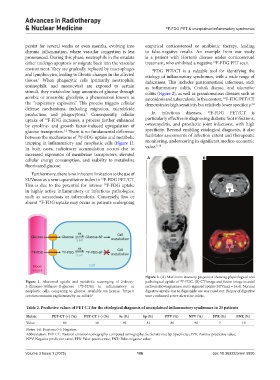
            stimuli, they metabolize large amounts of glucose through   colitis (Figure 2), as well as granulomatous diseases such as
            aerobic or anaerobic glycolysis, a phenomenon known as   sarcoidosis and tuberculosis. In this context,  F-FDG PET/CT
                                                                                                18
            the “respiratory explosion.” This process triggers cellular   demonstrates high sensitivity but relatively lower specificity. 3,4
            defense mechanisms, including migration, microbicide
                                      2
            production, and phagocytosis.  Consequently, cellular   In  infectious  diseases,  18 F-FDG  PET/CT  is
                    18
            uptake of  F-FDG increases, a process further enhanced   particularly effective in diagnosing diabetic foot infections,
            by cytokine-  and growth factor-induced upregulation of   osteomyelitis, and prosthetic joint infections, with high
            glucose transporters.  There is no fundamental difference   specificity. Beyond enabling  etiological diagnosis, it  also
                            1,2
            between the mechanisms of  F-FDG uptake and metabolic   facilitates assessments of infection extent and therapeutic
                                  18
            trapping in inflammatory and neoplastic cells (Figure  1).   monitoring, underscoring its significant medico-economic
                                                                   5-10
            In both cases, radiotracer accumulation occurs due to   value.
            increased expression of membrane transporters, elevated
            cellular energy consumption, and inability to metabolize   A               B
            fluorinated glucose.
              Furthermore, there is no inherent limitation to the use of
            SUVmax as a semi-quantitative index in  F-FDG PET/CT.
                                            18
            This  is  due  to  the  potential for  intense  F-FDG  uptake
                                             18
            in highly active inflammatory or infectious pathologies,
            such  as  sarcoidosis  or  tuberculosis.  Conversely,  low  or
                  18
            absent  F-FDG uptake may occur in patients undergoing


                                                               Figure 2. (A) Maximum intensity projection showing physiological and
            Figure  1.  Abnormal uptake and metabolic scavenging of 2-deoxy-  pathological uptake of  F-FDG. (B) CT image and fusion image in axial
                                                                              18
            2-[fluorine-18]fluoro-D-glucose ( F-FDG) in inflammatory or   sections showing intense recto-sigmoid uptake (SUVmax = 16.4). Normal
                                   18
            neoplastic cells, comparing to glucose. Available via license: “https://  digestive uptake due to Biguanide use was ruled out. Biopsy of digestive
            creativecommons.org/licenses/by-nc-nd/4.0/         tract confirmed active ulcerative colitis.
            Table 2. Predictive values of PET-CT for the etiological diagnosis of unexplained inflammatory syndromes in 25 patients
            Metric     PET-CT (+) (%)  PET-CT (−) (%)  Se (%)  Sp (%)  PPV (%)   NPV (%)    FPR (%)   FNR (%)
            Value           60            40         93        81         86        90        7         19
            Notes: (+): Positive; (−): Negative.
            Abbreviation: PET-CT: Positron emission tomography-computed tomography; Se: Sensitivity; Sp: Specificity; PPV: Positive predictive value;
            NPV: Negative predictive value; FPR: False-positive rate; FNR: False-negative value.


            Volume 3 Issue 1 (2025)                        106                             doi: 10.36922/arnm.5895

