


Page 113 - ARNM-3-1
P. 113
Advances in Radiotherapy
            & Nuclear Medicine                                         18 F-FDG PET & unexplained inflammatory syndromes


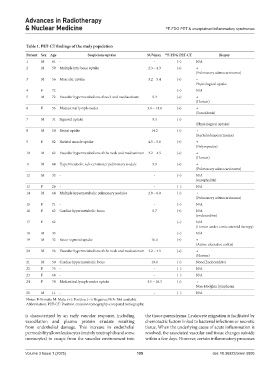
            Table 1. PET-CT findings of the study population
            Patient Sex Age           Suspicions uptake         SUVmax  18 F-FDG PET-CT       Biopsy
            1      M   61  -                                      -         (−)     N/A
            2      M   59  Multiple lytic bone uptake           2.3 – 4.3   (+)     +
                                                                                    (Pulmonary adenocarcinoma)
            3      M   56  Muscular uptake                      3.2 – 5.4   (+)     −
                                                                                    Physiological uptake
            4      F   72  -                                      -         (−)     N/A
            5      M   72  Vascular hypermetabolism of neck and mediastinum  5.3  (+)  +
                                                                                    (Horton)
            6      F   56  Mediastinal lymph-nodes              3.6 – 14.8  (+)     +
                                                                                    (Sarcoidosis)
            7      M   31  Sigmoid uptake                         9.4       (+)     −
                                                                                    (Physiological uptake)
            8      M   50  Rectal uptake                         14.2       (+)     +
                                                                                    (Rectal adenocarcinoma)
            9      F   82  Skeletal muscle uptake               4.5 – 5.6   (+)     +
                                                                                    (Polymyositis)
            10     M   62  Vascular hypermetabolism of the neck and mediastinum  3.2 – 4.5  (+)  +
                                                                                    (Horton)
            11     M   64  Hypermetabolic sub-centimeter pulmonary nodule  5.9  (+)  +
                                                                                    (Pulmonary adenocarcinoma)
            12     M   33  -                                      -         (−)     N/A
                                                                                    (encephalitis)
            13     F   26  -                                      -         (−)     N/A
            14     M   64  Multiple hypermetabolic pulmonary nodules  2.9 – 6.0  (+)  +
                                                                                    (Pulmonary adenocarcinoma)
            15     F   71  -                                      -         (−)     N/A
            16     F   62  Cardiac hypermetabolic focus           5.7       (+)     N/A
                                                                                    (endocarditis)
            17     F   62  -                                      -         (−)     N/A
                                                                                    (Horton under corticosteroid therapy)
            18     M   33  -                                      -         (−)     N/A
            19     M   32  Recto-sigmoid uptake                  16.4       (+)     +
                                                                                    (Active ulcerative colitis)
            20     M   56  Vascular hypermetabolism of the neck and mediastinum  3.2 – 4.5  (+)  +
                                                                                    (Horton)
            21     M   50  Cardiac hypermetabolic focus          19.0       (+)     None(Endocarditis)
            22     F   75  -                                      -         (−)     N/A
            23     F   68  -                                      -         (−)     N/A
            24     F   74  Mediastinal lymph-nodes uptake       4.5 – 10.3  (+)     +
                                                                                    Non-Hodgkin lymphoma
            25     M   11  -                                      -         (−)     N/A
            Notes: F: Female; M: Male; (+): Positive; (−): Negative; N/A: Not available.
            Abbreviation: PET-CT: Positron emission tomography-computed tomography.

            is characterized by an early vascular response, including   the tissue parenchyma. Leukocyte migration is facilitated by
            vasodilation  and  plasma  protein  exudate  resulting   chemotactic factors linked to bacterial infections or necrotic
            from endothelial damage. This increase in endothelial   tissue. When the underlying cause of acute inflammation is
            permeability allows leukocytes (mainly neutrophils and some   resolved, the associated vascular and tissue changes subside
            monocytes) to escape from the vascular environment into   within a few days. However, certain inflammatory processes


            Volume 3 Issue 1 (2025)                        105                             doi: 10.36922/arnm.5895

