


Page 69 - BH-2-2
P. 69
Brain & Heart                                                  The relationship between LE8 score and ASCVD


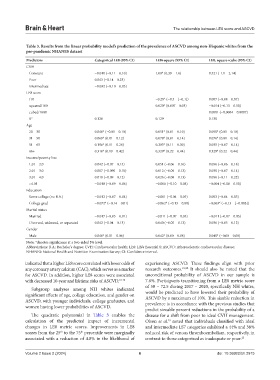
            Table 3. Results from the linear probability model’s prediction of the prevalence of ASCVD among non‑Hispanic whites from the
            pre‑pandemic NHANES dataset
            Predictors                   Categorical LE8 (95% CI)  LE8+square (95% CI)    LE8, square+cube (95% CI)
            CVH
             Constant                    −0.010 (−0.11 – 0.10)     1.00* (0.39 – 1.6)     0.521 (-1.1 – 2.14)
             Poor                        0.043 (−0.14 – 0.23)      -                      -
             Intermediate                −0.032 (−0.10 – 0.03)     -                      -
            LE8 score
             /10                         -                         −0.29* (−0.5 – [−0.1])  0.007 (−0.08 – 0.07)
             squared/100                 -                         0.020* (0.007 – 0.03)  −0.014 (−0.13 – 0.10)
             cubed/1000                  -                         -                      0.0001 (−0.0004 – 0.0007)
             R 2                         0.120                     0.129                  0.130
            Age
             20 – 30                     0.040* (−0.01 – 0.10)     0.051* (0.01 – 0.10)   0.050* (0.01 – 0.10)
             31 – 50                     0.069* (0.01 – 0.12)      0.078* (0.01 – 0.14)   0.076* (0.01 – 0.14)
             51 – 65                     0.196* (0.11 – 0.28)      0.203* (0.11 – 0.30)   0.035 (−0.07 – 0.14)
             66+                         0.310* (0.19 – 0.42)      0.329* (0.22 – 0.44)   0.329* (0.22 – 0.44)
            Income/poverty line
             1.01 – 2.0                  0.042 (−0.07 – 0.15)      0.051 (−0.06 – 0.16)   0.056 (−0.06 – 0.18)
             2.01 – 3.0                  0.007 (−0.090 – 0.10)     0.012 (−0.09 – 0.13)   0.030 (−0.07 – 0.14)
             3.01 – 4.0                  0.018 (−0.09 – 0.12)      0.026 (−0.08 – 0.13)   0.056 (−0.11 – 0.22)
             >4.01                       −0.018 (−0.09 – 0.06)     −0.006 (−0.10 – 0.08)  −0.004 (−0.08 – 0.10)
            Education
             Some college (no B.A.)      −0.012 (−0.07 – 0.04)     −0.001 (−0.04 – 0.05)  0.003 (−0.04 – 0.05)
             College grad                −0.072* (−0.14 – 0.01)    −0.062* (−0.13 – 0.00)  −0.063* (−0.13 – [−0.003])
            Marital status
             Married                     −0.017 (−0.05 – 0.01)     −0.011 (−0.07 – 0.05)  −0.011 (−0.07 – 0.05)
             Divorced, widowed, or separated  0.042 (−0.04 – 0.13)  0.040 (−0.05 – 0.13)  0.036 (−0.05 – 0.12)
            Gender
             Male                        0.040* (0.01 – 0.06)      0.042* (0.00 – 0.08)   0.040* (−0.00 – 0.08)
            Note: *denotes significance at a two-sided 5% level.
            Abbreviations: B.A.: Bachelor’s degree; CVH: Cardiovascular health; LE8: Life’s Essential 8; ASCVD: Atherosclerotic cardiovascular disease;
            NHANES: National Health and Nutrition Examination Survey; CI: Confidence interval.

            indicated that a higher LE8 score correlated with lower odds of   experiencing  ASCVD. These findings  align with  prior
            any coronary artery calcium (CAC), which serves as a marker   research outcomes. 21,22  It should also be noted that the
            for ASCVD. In addition, higher LE8 scores were associated   unconditional probability of ASCVD in our sample is
            with decreased 10-year and lifetime risks of ASCVD. 18-20  7.8%. Participants transitioning from a LE8 metric score
                                                               of 50 – 72.5 during 2017 – 2020, specifically NH whites,
              Subgroup analyses among NH whites indicated
            significant effects of age, college education, and gender on   would be predicted to have lowered their probability of
            ASCVD, with younger individuals, college graduates, and   ASCVD by a maximum of 10%. This sizable reduction in
                                                               prevalence is in accordance with the previous studies that
            women having lower probabilities of ASCVD.
                                                               predict sizeable percent reductions in the probability of a
              The  quadratic  polynomial  in  Table  3  enables  the   disease for a shift from poor to ideal CVH management.
            calculation of the predicted impact of incremental   Olson et al.  noted that individuals classified with ideal
                                                                        23
            changes in LE8 metric scores. Improvements in LE8   and intermediate LS7 categories exhibited a 44% and 38%
            scores from the 25  to the 75  percentile were marginally   reduced risk of venous thromboembolism, respectively, in
                           th
                                   th
            associated with a reduction of 4.8% in the likelihood of   contrast to those categorized as inadequate or poor. 23
            Volume 2 Issue 2 (2024)                         6                                doi: 10.36922/bh.2915

