


Page 67 - BH-2-2
P. 67
Brain & Heart                                                  The relationship between LE8 score and ASCVD


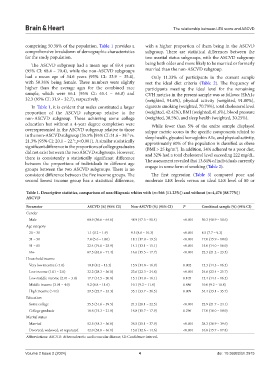
            comprising 50.38% of the population. Table 1 provides a   with a higher proportion of them being in the ASCVD
            comprehensive breakdown of demographic characteristics   subgroup.  There  are  statistical  differences  between  the
            for the study population.                          two marital status subgroups, with the ASCVD subgroup
              The ASCVD subgroup had a mean age of 69.4  years   being both older and more likely to be married or formerly
            (95% CI: 68.4 – 70.4), while the non-ASCVD subgroups   married than the non-ASCVD subgroup.
            had a mean age of 34.6  years (95% CI: 33.9 – 35.4),   Only 11.33% of participants in the current sample
            with 50.38% being female. These numbers were slightly   met the ideal diet criteria (Table 2). The frequency of
            higher  than  the  average  ages  for  the  combined  race   participants meeting the ideal level for the remaining
            sample, which were 66.1  (95% CI: 65.4 – 66.8) and   CVH metrics in the present sample was as follows: HbA1c
            32.3 (95% CI: 31.9 – 32.7), respectively.          (weighted, 94.6%), physical activity (weighted, 91.80%),
              In Table 1, it is evident that males constituted a larger   cigarette smoking (weighted, 70.79%), total cholesterol level
            proportion of the ASCVD subgroup relative to the   (weighted, 42.42%), BMI (weighted, 41.6%), blood pressure
            non-ASCVD subgroup. Those achieving some college   (weighted, 38.5%), and sleep health (weighted, 30.25%).
            education  but  without  a  4-year  degree  completion  were   While fewer  than  5%  of the entire  sample  displayed
            overrepresented in the ASCVD subgroup relative to those   subpar metric scores in the specific components related to
            in the non-ASCVD subgroup (35.5% [95% CI: 31.6 – 39.  vs.   sleep health, glycated hemoglobin A1c, and physical activity,
                                                       5
            21.3% [95% CI: 20.1 – 22. ; p<0.001). A similar statistically   approximately 60% of the population is classified as obese
                                5
            significant difference in the proportions of college graduates   (BMI > 25 kg/m ). In addition, 34% adhered to a poor diet,
                                                                            2
            did not exist between the two ASCVD subgroups. However,   and 32% had a total cholesterol level exceeding 222 mg/dL.
            there is consistently a statistically significant difference   The assessment revealed that 13.64% of individuals currently
            between the proportions of individuals in different age   engage in some form of smoking (Table 2).
            groups between the two ASCVD subgroups. There is no
            consistent difference between the five income groups. The   The first regression (Table 3) compared poor and
            second lowest income group has a statistical difference,   moderate LE8 levels versus an ideal LE8 level of 80 or

            Table 1. Descriptive statistics, comparison of non‑Hispanic whites with (n=566 [11.23%]) and without (n=4,476 [88.77%])
            ASCVD
            Parameter                 ASCVD (%) (95% CI)  Non‑ASCVD (%) (95% CI)  P    Combined sample (%) (95% CI)
            Gender
             Male                     60.9 (56.6 – 64.6)  48.9 (47.5 – 50.4)   <0.001  50.3 (48.9 – 50.6)
            Age category
             20 – 30                  1.1 (0.2 – 1.9)    9.5 (8.6 – 10.3)      <0.001  8.5 (7.7 – 9.3)
             31 – 50                  7.8 (5.6 – 10.0)   18.1 (17.0 – 19.3)    <0.001  17.0 (15.9 – 18.0)
             51 – 65                  22.4 (19.0 – 25.9)  14.1 (13.1 – 15.1)   <0.001  15.0 (14.0 – 16.0)
             66+                      67.5 (63.6 – 71.4)  16.6 (15.5 – 17.7)   <0.001  22.3 (21.2 – 23.5)
            Household income
             Very low income (<1.0)   10.8 (8.2 – 13.3)  15.9 (14.8 – 16.9)    0.002   15.3 (14.3 – 16.3)
             Low income (1.01 – 2.0)  32.2 (28.3 – 36.0)  23.6 (22.3 – 24.8)   <0.001  24.6 (23.4 – 25.7)
             Low middle income (2.01 – 3.0)  17.7 (14.5 – 20.8)  15.1 (14.0 – 16.1)  0.105  15.4 (14.4 – 16.3)
             Middle income (3.01 – 4.0)  9.2 (6.8 – 11.6)  10.1 (9.2 – 11.0)   0.486   10.0 (9.2 – 10.8)
             High income (>4.0)       29.5 (25.7 – 33.3)  35.1 (33.7 – 36.5)   0.009   34.4 (33.1 – 35.7)
            Education
             Some college             35.5 (31.6 – 39.5)  21.3 (20.1 – 22.5)   <0.001  22.9 (21.7 – 24.1)
             College graduate         18.6 (15.3 – 21.8)  16.8 (15.7 – 17.9)   0.296   17.0 (16.0 – 18.0)
            Marital status
             Married                  52.5 (48.3 – 56.6)  36.5 (35.1 – 37.9)   <0.001  38.3 (36.9 – 39.6)
             Divorced, widowed, or separated  42.0 (38.0 – 46.1)  13.6 (12.6 – 14.6)  <0.001  16.8 (15.7 – 17.8)
            Abbreviations: ASCVD: Atherosclerotic cardiovascular disease; CI: Confidence interval.


            Volume 2 Issue 2 (2024)                         4                                doi: 10.36922/bh.2915

