


Page 105 - DP-2-1
P. 105
Design+                                                                   AI’s role in medical history taking


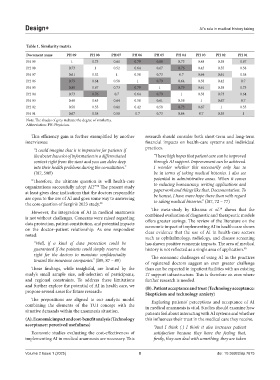
            Table 1. Similarity matrix
            Document name    PH 09     PH 08    PH 07    PH 06     PH 05    PH 04   PH 03    PH 02    PH 01
            PH 09              1        0.73     0.61     0.79      0.88     0.73    0.48     0.58     0.67
            PH 08             0.73       1       0.52     0.64      0.67     0.76    0.45     0.55     0.58
            PH 07             0.61      0.52      1       0.58      0.73     0.7     0.64     0.61     0.58
            PH 06             0.79      0.64     0.58      1        0.79     0.64    0.58     0.42      0.7
            PH 05             0.88      0.67     0.73     0.79       1       0.79    0.61     0.58     0.73
            PH 04             0.73      0.76      0.7     0.64      0.79      1      0.58     0.73     0.64
            PH 03             0.48      0.45     0.64     0.58      0.61     0.58     1       0.67      0.7
            PH 02             0.58      0.55     0.61     0.42      0.58     0.73    0.67      1       0.55
            PH 01             0.67      0.58     0.58      0.7      0.73     0.64     0.7     0.55      1
            Note: The shades of grey indicate the degree of similarity.
            Abbreviation: PH: Physician.

              This efficiency gain is further exemplified by another   research should consider both short-term and long-term
            interviewee:                                       financial impacts on health-care systems and individual
               “I could imagine that it is impressive for patients if   practices.
               the doctor has a lot of information in a differentiated      “I have high hopes that patient care can be improved
               context right from the start and you can delve deep   through AI support. Improvement can be achieved.
               into their health problems during the consultation.”   I  wonder  whether  this  necessarily  only  has  to
               (I07, 59ff)                                        be in terms of taking medical histories. I also see
              “Therefore, the ultimate question is: will health-care   potential in administrative areas. When it comes
            organizations successfully adopt AI?”  The present study   to reducing bureaucracy, writing applications and
                                          38
                                                                  paperwork and things like that. Documentation. To
            at least gives clear indications that the doctors responsible   be honest, I have more hope there than with regard
            are open to the use of AI and goes some way to answering   to taking medical histories.” (I07, 72 – 77)
            the core question of Sezgin’s 2023 study. 38
                                                                 The meta-study by Khanna  et al.  shows that the
                                                                                              39
              However, the integration of AI in medical anamnesis
            is not without challenges. Concerns were raised regarding   combined evaluation of diagnostic and therapeutic models
            data protection, patient constitution, and potential impacts   offers greater savings. The review of the literature on the
                                                               economic impact of implementing AI in health-care shows
            on the doctor–patient relationship. As one respondent   clear evidence that the use of AI in health-care sectors
            noted:
                                                               such as ophthalmology, radiology, and disease screening
               “Well, if a kind of data protection could be    has shown positive economic impacts. The area of medical
               guaranteed if the patients could simply reserve the   history is not reflected as a single area of application. 40
               right for the doctors to maintain confidentiality   The economic challenges of using AI in the practices
               toward the insurance companies.” (I09, 87 – 89)
                                                               of registered doctors suggest an even greater challenge
              These findings, while insightful, are limited by the   than can be expected in inpatient facilities with an existing
            study’s small sample size, self-selection of participants,   IT support infrastructure. This is therefore an area where
            and regional constraints. To address these limitations   further research is needed.
            and further explore the potential of AI in health care, we   (B). Patient acceptance and trust (Technology acceptance:
            propose several areas for future research:         Skepticism and technology anxiety)
              The prepositions are aligned to our analytic model   Exploring patients’ perceptions and acceptance of AI
            combining the elements of the TUI concept with the   in medical anamnesis is vital. Studies should examine how
            situative demands within the anamnesis situation.  patients feel about interacting with AI systems and whether
            (A). Economic impact and cost-benefit analysis (Technology   this influences their trust in the medical care they receive.
            acceptance: perceived usefulness)
                                                                  “And I  think (.) I  think it also increases  patient
              Economic studies evaluating the cost-effectiveness of   satisfaction because they have the feeling that,
            implementing AI in medical anamnesis are necessary. This   firstly, they can deal with something, they are taken


            Volume 2 Issue 1 (2025)                         8                                doi: 10.36922/dp.7675

