


Page 100 - DP-2-1
P. 100
Design+                                                                   AI’s role in medical history taking


                                                               2.  Identifying  potential  efficiency  and  quality
                                                                  improvements
                                                               3.  Highlighting integration challenges
                                                               4.  Outlining key areas for future research
                                                               5.  Providing insights into AI adoption in health care
                                                               6.  Acknowledging limitations and research gaps
                                                               7.  Emphasizing the need for interdisciplinary research
                                                               8.  Offering practical implications for AI tool development
                                                                  and implementation.
                                                                 These findings contribute to the broader understanding
                                                               of AI’s role in health-care explicitly in medical history
                                                               taking and provide a foundation for further research and
                                                               development in this field.

                                                               2. Methods
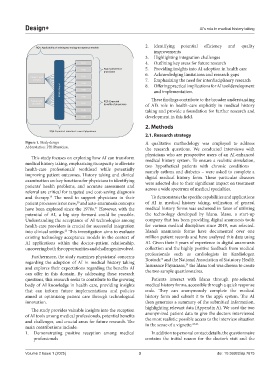
                                                               2.1. Research strategy
            Figure 1. Study design                             A qualitative methodology was employed to address
            Abbreviation: PH: Physician.                       the research questions. We conducted interviews with
                                                               physicians who are prospective users of an AI-enhanced
              This study focuses on exploring how AI can transform   medical history system. To ensure a realistic simulation,
            medical history taking, emphasizing its capacity to alleviate   two hypothetical patients with chronic conditions –
            health-care professionals’ workload while potentially   namely asthma and diabetes – were asked to complete a
            improving patient outcomes. History taking and clinical   digital medical history form. These particular diseases
            examination are key functions for physicians in identifying   were selected due to their significant impact on treatment
            patients’ health problems, and accurate assessment and   across a wide spectrum of medical specialties.
            referral are critical for targeted and cost-saving diagnosis
            and therapy.  The need to support physicians in their   To demonstrate the specific capabilities and applications
                      19
            patient processes is not new,  and auto-anamnesis concepts   of  AI in  medical history  taking, utilization  of general
                                  20
            have been explored since the 1970s.  However, with the   medical history forms was eschewed in favor of utilizing
                                         21
            potential of AI, a big step forward could be possible.   the technology developed by Idana. Idana, a start-up
            Understanding the acceptance of AI technologies among   company that has been providing digital anamnesis tools
            health-care providers is crucial for successful integration   for  various  medical  disciplines  since  2019,  was  selected.
                             22
            into clinical settings.  This investigation aims to evaluate   Idana’s anamnesis forms have documented over one
            existing technology acceptance models in the context of   million patient records and have analyzed this data using
            AI  applications  within  the  doctor–patient  relationship,   AI. Given their 5 years of experience in digital anamnesis
            uncovering both the opportunities and challenges involved.  collection and the highly positive feedback from medical
                                                               professionals  such  as  cardiologists  in  Kardiologen
              Furthermore, the study examines physicians’ concerns   23
            regarding the adoption of AI in medical history taking   Rostock  and the National Association of Statutory Health
                                                               Insurance Physicians,  the Idana tool was chosen to create
                                                                                24
            and explores their expectations regarding the benefits AI   the two sample questionnaires.
            can offer in this domain. By addressing these research
            questions, this research seeks to contribute to the growing   Patients interact with Idana through pre-selected
            body of AI knowledge in health care, providing insights   medical history forms, accessible through a quick response
            that can inform future implementations and policies   code. They can anonymously complete the medical
            aimed at optimizing patient care through technological   history form and submit it to the app’s system. The AI
            innovation.                                        then generates a summary of the submitted information,
                                                               highlighting relevant data (Appendix A). We used the two
              The study provides valuable insights into the reception
            of AI tools among medical professionals, potential benefits   anonymized patient data to give the doctors interviewed
                                                               the most realistic possible access to the interview situation
            and challenges, and crucial areas for future research. The             25,26
            main contributions include:                        in the sense of a vignette.
            1.  Demonstrating positive reception among medical   In addition to personal contact details, the questionnaire
               professionals                                   contains the initial reason for the doctor’s visit and the


            Volume 2 Issue 1 (2025)                         3                                doi: 10.36922/dp.7675

