


Page 102 - DP-2-1
P. 102
Design+                                                                   AI’s role in medical history taking


            transcription method. The clear transcription rules
            used in this approach contribute not only to scientific
            reproducibility but also help maintain focus during both
            transcription and subsequent reading. Kuckartz supports
            this  view,  noting  that  deliberately  simple  and  quickly
            learnable transcription rules smooth out the language
            and emphasize the semantic content of the utterances.
                                                         31
            By applying this transcription method, the data collected
            were precisely captured and subsequently analyzed
            efficiently. The structured transcription process following
            Dresing and Pehl’s guidelines enabled systematic analysis
            of the interview content, significantly contributing to
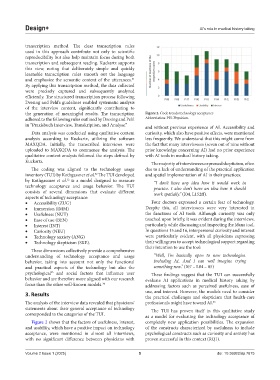
            the generation of meaningful results. The transcription   Figure 2. Code trends technology acceptance
            adhered to the following rules outlined by Dresing and Pehl   Abbreviation: PH: Physician.
            in “Praxisbuch Interview, Transkription, and Analyse.”  and without previous experience of AI. Accessibility and
              Data analysis was conducted using qualitative content   curiosity, which also have positive effects, were mentioned
            analysis according to Kuckartz, utilizing the software   less frequently. We understand that this might come from
            MAXQDA. Initially, the transcribed interviews were   the fact that many interviewees (seven out of nine without
            uploaded to MAXQDA to commence the analysis. The   prior knowledge concerning AI) had no prior experience
            qualitative content analysis followed the steps defined by   with AI tools in medical history taking.
            Kuckartz.                                            The majority of interviewees expressed skepticism, often
              The coding was aligned to the technology usage   due to a lack of understanding of the practical application
            inventory (TUI) by Kothgassner et al.  The TUI developed   and spatial implementation of AI in their practices:
                                         32
            by Kothgassner  et al.  is a model designed to measure      “I don’t have any idea how it would work in
                             32
            technology acceptance and usage behavior. The TUI     practice. I also don’t have an idea how it should
            consists of several dimensions that evaluate different   work spatially.” (I04, L152ff).
            aspects of technology acceptance:
            •   Accessibility (ZUG)                              Four doctors expressed a certain fear of technology.
            •   Immersion (IMM)                                Despite this, all interviewees were very interested in
            •   Usefulness (NUT)                               the functions of AI tools. Although curiosity was only
            •   Ease of use (BEN)                              touched upon briefly, it was evident during the interviews,
            •   Interest (INT)                                 particularly while discussing and inspecting the Idana tool.
            •   Curiosity (NEU)                                In questions 15 and 16, interpersonal curiosity and interest
            •   Technology anxiety (ANG)                       were particularly evident, with all physicians expressing
            •   Technology skepticism (SKE).                   their willingness to accept technological support regarding
                                                               their intention to use the tool:
              These dimensions collectively provide a comprehensive
            understanding of technology acceptance and usage      “Well, I’m basically open to new technologies.
            behavior, taking into account not only the functional   Including AI. And I can well imagine trying
            and practical aspects of the technology but also the   something new.” (I07 – L84 – 85)
            psychological   and  social  factors  that  influence  user   These findings suggest that the TUI can successfully
                       33
            behavior and are therefore more aligned with our research   evaluate  AI  applications  in  medical  history  taking  by
            focus than the other well-known models. 34         addressing factors such as perceived usefulness, ease of
            3. Results                                         use, and interest. However, the models need to consider
                                                               the practical challenges and skepticism that health-care
            The analysis of the interview data revealed that physicians’   professionals might have toward AI. 35
            statements about  their  general  acceptance  of technology   The TUI has proven itself in this qualitative study
            corresponded to the categories of the TUI.         as a model for evaluating the technology acceptance of
              Figure 2 shows that the factors of usefulness, interest,   completely new application possibilities. The expansion
            and usability, which have a positive impact on technology   of the constructs characterized by usefulness to include
            acceptance, were mentioned in almost all interviews,   psychological constructs such as curiosity and anxiety has
            with no significant difference between physicians with   proven successful in this context (RQ1).


            Volume 2 Issue 1 (2025)                         5                                doi: 10.36922/dp.7675

