


Page 73 - DP-2-1
P. 73
Design+                                                                    Evaluating a building code app


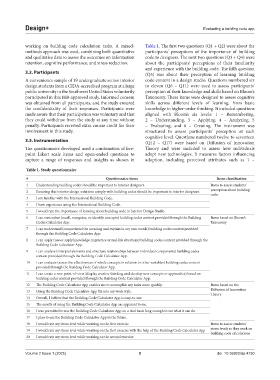
            working  on  building  code  calculation  tasks.  A  mixed-  Table 1. The first two questions (Q1 + Q2) were about the
            methods approach was used, combining both quantitative   participants’ perceptions of the importance of building
            and qualitative data to assess the outcomes on information   code to designers. The next two questions (Q3 + Q4) were
            retention, cognitive performance, and stress reduction.  about the participants’ perceptions of their familiarity
                                                               and experience with the building code. The fifth question
            3.2. Participants                                  (Q5) was about their perception of learning building
            A convenience sample of 19 undergraduate senior interior   code content in a design studio. Questions numbered six
            design students from a CIDA-accredited program at a large   to eleven (Q6 – Q11)  were used to assess participants’
            public university in the Southwest United States voluntarily   perception of their knowledge and skills based on Bloom’s
            participated in this IRB-approved study. Informed consent   Taxonomy. These items were designed to assess cognitive
            was obtained from all participants, and the study ensured   skills across different levels of learning, from basic
            the confidentiality of their responses. Participants were   knowledge to higher-order thinking. It included questions
            made aware that their participation was voluntary and that   aligned with Bloom’s six levels: 1 – Remembering,
            they could withdraw from the study at any time without   2 – Understanding, 3 – Applying, 4 – Analyzing, 5
            penalty. Participants received extra course credit for their   – Evaluating, and 6 – Creating. The instrument was
            involvement in this study.                         structured to assess participants’ perception at each
                                                               cognitive level. Questions numbered twelve to seventeen
            3.3. Instrumentation                               (Q12  –  Q17) were  based  on  Diffusion  of  Innovation
            The questionnaire developed used a combination of five-  Theory and were included to assess how individuals
            point  Likert  scale  items  and  open-ended  questions  to   adopt new technologies. It measures factors influencing
            capture a range of responses and insights as shown in   adoption, including perceived attributes such as 1 –
            Table 1. Study questionnaire

            #                                 Questionnaire items                            Items classification
            1   Understanding building codes should be important to interior designers.    Items to assess students’
            2   Ensuring that interior design solutions comply with building codes should be important to interior designers.  perception about building
                                                                                           code
            3   I am familiar with the International Building Code.
            4   I have experience using the International Building Code.
            5   I would rate the importance of learning about building code in Interior Design Studio
            6   I can remember (recall, recognize, or identify concepts) building codes content provided through the Building   Items based on Bloom’s
                Codes Calculator App.                                                      Taxonomy
            7   I can understand (comprehend the meaning and explain in my own words) building codes content provided
                through the Building Code Calculator App.
            8   I can apply (use or apply knowledge in practice or real-life situations) building codes content provided through the
                Building Code Calculator App.
            9   I can analyze (interpret elements and structure relationships between individual components) building codes
                content provided through the Building Code Calculator App.
            10  I can evaluate (assess the effectiveness of whole concepts in relation to other variables) building codes content
                provided through the Building Code Calculator App.
            11  I can create a new point-of-view (display creative thinking and develop new concepts or approaches) based on
                building codes content provided through the Building Code Calculator App.
            12  The Building Code Calculator App enables me to accomplish my tasks more quickly.  Items based on the
            13  Using the Building Code Calculator App fits into my work style.            Diffusion of Innovation
                                                                                           Theory
            14  Overall, I believe that the Building Code Calculator App is easy-to-use.
            15  The results of using the Building Code Calculator App are apparent to me.
            16  I was permitted to use the Building Code Calculator App on a trial basis long enough to see what it can do.
            17  I plan to use the Building Code Calculator App in the future.
            18  I would rate my stress level while working on the first exercise           Items to assess students’
            19  I would rate my stress level while working on the first exercise with the help of the Building Code Calculator App  stress levels as they work on
                                                                                           building code calculations
            20  I would rate my stress level while working on the second exercise


            Volume 2 Issue 1 (2025)                         5                                doi: 10.36922/dp.4730

