


Page 105 - DP-2-2
P. 105
Design+                                                                 Modern interpretations of probability


              This means that in the mathematical function     categories, as well as the essence of the mutual penetration
            “probability,” the argument “time” should be taken into   (certain fusion) of the concepts of logic and probability,
            account as well, for after some time, in the future, as   and the consequences of this process, can be understood
            the amount of knowledge increases, some stochastic   exclusively within  the  framework  of the  corresponding
            phenomena will pass for a future person into the category   historical discourse.
            of deterministic ones. However, when analyzing complex   Logic is believed to have originated in the fourth century
            phenomena, such as social processes, which influence not   BC in ancient Greece and was associated with oratory. At
            just the actions of an individual but the behavior of millions   that time, logic and rhetoric reflected mastering the basics
            of people over decades or even centuries, it is certainly   of argumentation, logical rules of proof, and forming forms
            impossible to describe these processes analytically, neither   of thinking. It took a long time before the works of Francis
            now nor even in the future. Thus, the distance between the   Bacon, René Descartes, and Gottfried Leibniz directed
            probable and the obligatory deterministic is represented   logic (already as a science) to form conclusions based on
            by the phenomenon’s cognition level. Hence, the corollary   judgments. The English scientist F. Bacon, the founder of
            follows:  the  more comprehensive  our  knowledge,  the   scientific induction and inductive logic, was one of the
            less likely phenomena appear to us. However, a person   first to turn to experiments in his research. He proclaimed
            remains such that achieving goals causes the emergence of   induction, the movement of thoughts from individual facts
            new, more complex goals, demonstrating the restless and
            boundless curiosity of humans.                     (hypotheses) to generalizing conclusions, as a  universal
                                                               research method.  French philosopher R. Descartes
              Of course, the world is cognizable. But at any moment,   supported deductive logic, which aimed at establishing the
            the ratio between the cognizable  and the cognizable   truth of specific facts based on general conclusions. German
            will, unfortunately (or, fortunately), favor the latter. This   philosopher G. Leibniz was the first to suggest the necessity
            means that the ratio between deterministic and random   of creating symbolic or mathematical logic. The portrait of
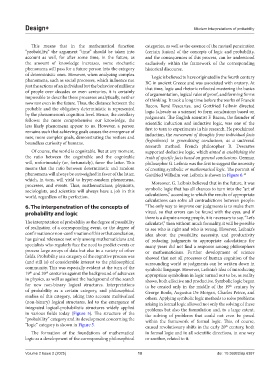
            phenomena will always be outweighed in favor of the latter,   Gottfried Wilhelm von Leibniz is shown in Figure 6. 16
            which, in turn, will yield to hyper-random phenomena,
            processes, and events. Thus, mathematicians, physicists,   Moreover, G. Leibniz believed that in the future, it was
            sociologists, and scientists will always have a job in this   symbolic logic that has all chances to turn into the “art of
            world, regardless of its perfection.               calculations,” according to which the results of appropriate
                                                               calculations can solve all contradictions between people:
            6. The interpenetration of the concepts of         “The only way to improve our judgments is to make them
            probability and logic                              visual, so that errors can be found with the eyes, and if
                                                               there is a dispute among people, it is necessary to say, “Let’s
            The interpretation of probability as the degree of possibility   calculate!,” then without much formality, it will be possible
            of realization of a corresponding event, or the degree of   to see who is right and who is wrong. However, Leibniz’s
            confirmation or non-confirmation of this or that conclusion,   idea about the possibility, necessity, and productivity
            has gained relevance not only among mathematicians and   of reducing judgments to  appropriate  calculations  for
            specialists who regularly face the need to predict events or   many years did not find a response among philosophers
            process large arrays of data but also in a variety of other   or mathematicians. Further development of science
            fields. Probability as a category of the cognitive process was   showed that not all processes of human cognition of the
            (and still is) of considerable interest to the philosophical   surrounding world or judgments can be written down in
            community. This was especially evident at the turn of the   symbolic language. However, Leibniz’s idea of introducing
            19  and 20  centuries against the background of advances   appropriate symbolism in logic turned out to be, as reality
                     th
              th
            in physics, as well as against the background of the search   shows, both effective and productive. Symbolic logic began
            for new non-binary logical structures. Interpretations   to be created only in the middle of the 19   century by
                                                                                                   th
            of probability as a certain category, and philosophical   George Boole, Augustus De Morgan, Charles Peirce, and
            studies of this category, taking into account multivalued   others. Applying symbolic logic methods to solve problems
            (non-binary) logical structures, led to the emergence of   arising in formal logic allowed not only the solving of these
            integrated logical-probabilistic structures widely applied   problems but also the formulation and, to a large extent,
            in various fields today (Figure  5). The structure of the   the solving of problems that could not even be posed
            “probability” category and its development concerning the   within the framework of formal logic. This, of course,
            “logic” category is shown in Figure 5.             caused revolutionary shifts in the early 20  century, both
                                                                                                 th
              The  formation  of the  foundations  of  mathematical   in formal logic and in all scientific directions, in one way
            logic as a development of the corresponding philosophical   or another, related to it.


            Volume 2 Issue 2 (2025)                         10                               doi: 10.36922/dp.6387

