


Page 34 - DP-2-2
P. 34
Design+                                                                   Climate-adaptive clothing design


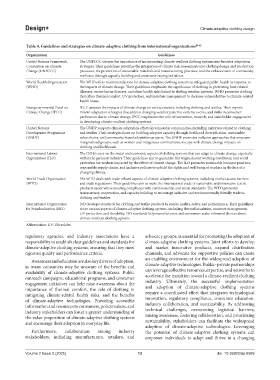
            Table 4. Guidelines and strategies on climate‑adaptive clothing from international organizations 40‑42
            Organization                                            Guidelines
            United Nations Framework   The UNFCCC stresses the importance of incorporating climate-resilient clothing systems into broader adaptation
            Convention on Climate   strategies. Their guidelines prioritize the integration of climate risk assessments into clothing design and production
            Change (UNFCCC)        processes, the promotion of sustainable materials and manufacturing practices, and the enhancement of community
                                   resilience through capacity building and awareness-raising initiatives.
            World Health Organization   The WHO offers recommendations for climate-adaptive clothing systems to safeguard public health in response to
            (WHO)                  the impacts of climate change. Their guidelines emphasize the significance of clothing in preventing heat-related
                                   illnesses, vector-borne diseases, and other health risks linked to shifting weather patterns. WHO promotes clothing
                                   that offers thermal comfort, UV protection, and moisture management to decrease vulnerabilities to climate-related
                                   health issues.
            Intergovernmental Panel on   IPCC assesses the impacts of climate change on various sectors, including clothing and textiles. Their reports
            Climate Change (IPCC)  inform adaptation strategies that address changing weather patterns, extreme events, and shifts in consumer
                                   preferences due to climate change. IPCC emphasizes the role of innovation, research, and stakeholder engagement
                                   in developing climate-resilient clothing systems.
            United Nations         The UNDP supports climate adaptation efforts in vulnerable communities, including initiatives related to clothing
            Development Programme   and textiles. Their strategies focus on building adaptive capacity through livelihood diversification, sustainable
            (UNDP)                 value chains, and community-based adaptation projects. The UNDP promotes inclusive approaches that empower
                                   marginalized groups, such as women and indigenous communities, to cope with climate change impacts on
                                   clothing and livelihoods.
            International Labour   The ILO focuses on the social and economic aspects of clothing systems that can adapt to climate change, especially
            Organization (ILO)     within the garment industry. Their guidelines aim to guarantee fair wages, decent working conditions, and social
                                   protection for workers impacted by the effects of climate change. The ILO promotes sustainable business practices,
                                   responsible supply chains, and inclusive policies to uphold the rights and well-being of workers in the face of a
                                   changing climate.
            World Trade Organization   The WTO deals with trade-related aspects of climate-adaptive clothing systems, including market access barriers
            (WTO)                  and trade regulations. Their guidelines aim to make the international trade of sustainable and innovative textile
                                   products easier when ensuring compliance with environmental and social standards. The WTO promotes
                                   transparency, cooperation, and capacity building to encourage inclusive and environmentally friendly trade in
                                   clothing and textiles.
            International Organization   ISO develops standards for clothing and textile products to ensure quality, safety, and performance. Their guidelines
            for Standardization (ISO)  cover various aspects of climate-adaptive clothing systems, including thermal insulation, moisture management,
                                   UV protection, and durability. ISO standards help manufacturers and consumers make informed choices about
                                   climate-resilient clothing options.
            Abbreviation: UV: Ultraviolet.

            regulatory agencies, and industry associations have a   advocacy groups, is essential for promoting the adoption of
            responsibility to establish clear guidelines and standards for   climate-adaptive clothing systems. Joint efforts to develop
            climate-adaptive clothing systems, ensuring that they meet   and market innovative products, expand distribution
            rigorous quality and performance criteria.         channels, and advocate for supportive policies can create
              Awareness and education are also key drivers of adoption,   an enabling environment for the widespread adoption of
            as many consumers may be unaware of the benefits and   climate-adaptive technologies. Public–private partnerships
            availability  of  climate-adaptive  clothing  systems.  Public   can leverage collective resources, expertise, and networks to
            outreach campaigns, educational programs, and consumer   accelerate the transition toward a climate-resilient clothing
            engagement initiatives can help raise awareness about the   industry. Ultimately, the successful implementation
            importance of thermal comfort, the role of clothing in   and adoption of climate-adaptive clothing systems
            mitigating climate-related health risks, and the benefits   require a coordinated effort that integrates technological
            of climate-adaptive technologies. Providing accessible   innovation, regulatory compliance, consumer education,
            information and resources to consumers, policymakers, and   industry collaboration, and sustainability. By addressing
            industry stakeholders can foster a greater understanding of   technical challenges,  overcoming logistical barriers,
            the value proposition of climate-adaptive clothing systems   raising awareness, fostering collaboration, and prioritizing
            and encourage their adoption in everyday life.     sustainability, stakeholders can facilitate the widespread
                                                               adoption of climate-adaptive technologies. Leveraging
              Furthermore,   collaboration  among  industry    the potential of climate-adaptive clothing systems can
            stakeholders, including  manufacturers, retailers, and   empower individuals to adapt and thrive in a changing


            Volume 2 Issue 2 (2025)                         13                               doi: 10.36922/dp.8589

