


Page 112 - DP-2-3
P. 112
Design+                                                              Building code app benefits for designers


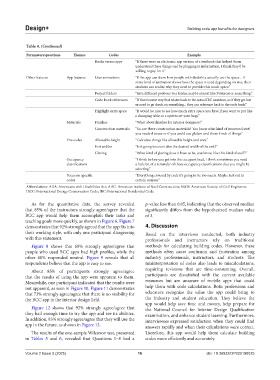
            Table 4. (Continued)
            Parameters/questions  Themes       Codes                             Example
                                         Books versus apps  “If there were an electronic app version of a textbook that helped them
                                                           understand these things and by plugging in information, I think they’d be
                                                           willing to pay for it.”
            Other features   App features  User animations  “If the app can show how people with disability actually use the space... if
                                                           some kind of animation shows how the space is used depending on size, then
                                                           students can realize why they need to provide this much space.”
                                         Project folders   “Save different portions to a folder, maybe almost like Pinterest or something.”
                                         Code book references  “If there’s some way that relates back to the actual IBC numbers, so if they get lost
                                                           or need to go check on something... they can reference back to the code book.”
                                         Highlight extra space  “It would be nice to see how much extra space you have if you want to put like
                                                           a changing table or a spot to set your bags.”
                             Materials   Finishes          “What about finishes for interior designers?”
                                         Construction materials  “So, are there construction materials? You know what kind of structural steel
                                                           you needed to use or if you could use glulam and those kinds of things.”
                             Fire codes  Allowable height  “Calculate things like allowable height and area.”
                                         Exit widths       “Is it going to count also the desired width of the exit?”
                                         Glazing           “What kind of glazing does it have to be, you know, like this kind of stuff?”
                             Occupancy                     “I think before you get into the occupant load, I think sometimes you need
                             classifications               a little bit of a reminder of those occupancy classifications that you might be
                                                           selecting.”
                             Focus on specific             “Everything covered by code it’s going to be too much. Maybe tailored to
                             codes                         certain courses.”
            Abbreviations: ADA: Americans with Disabilities Act; AISC: American Institute of Steel Construction; ASCE: American Society of Civil Engineers;
            IECC: International Energy Conservation Code; IRC: International Residential Code.

              As for the quantitative data, the survey revealed   p-value less than 0.05, indicating that the observed median
            that 85% of the instructors strongly agree/agree that the   significantly differs from the hypothesized median value
            BCC app would help them accomplish their tasks and   of 3.
            teaching goals more quickly, as shown in Figure 6. Figure 7
            demonstrates that 92% strongly agreed that the app fits into   4. Discussion
            their working style, with only one participant disagreeing   Based  on  the interviews  conducted,  both  industry
            with this statement.                               professionals and instructors rely on traditional

              Figure  8 shows that 60% strongly agree/agree that   methods for calculating building codes. However, these
            people who used BCC apps had high profiles, while the   methods often cause confusion and frustration among
            other 40% responded neutral.  Figure  9 reveals that all   industry professionals, instructors, and students. The
            respondents believe that the app is easy to use.   misinterpretation of codes also leads to miscalculations,
              About 85% of participants strongly agree/agree   requiring revisions that are time-consuming. Overall,
            that the results of using the app were apparent to them.   participants are dissatisfied with the current available
            Meanwhile, one participant indicated that the results were   resources  but  are  unaware of mobile  apps  that could
            not apparent, as seen in Figure 10. Figure 11 demonstrates   help them with code calculations. Both professions and
            that 73% strongly agree/agree that there is no visibility for   educators recognize the value the app could bring to
            the BCC app in the interior design field.          the industry and student education. They believe the
                                                               app would  help save  time and  money, help  prepare for
              Figure  12 shows that 92% strongly agree/agree that   the National Council for Interior Design Qualification
            they had enough time to try the app and see its abilities.   examination, and enhance student learning. Furthermore,
            In addition, 83% strongly agree/agree that they will use the   interviewees expressed satisfaction when they could find
            app in the future, as shown in Figure 13.          answers rapidly and when their calculations were correct.
              The results of the one-sample Wilcoxon test, presented   Therefore, this app would help them calculate building
            in  Tables  5 and  6, revealed that Questions 1–8 had a   codes more efficiently and accurately.


            Volume 2 Issue 3 (2025)                         16                           doi: 10.36922/DP025190025

